Master Affiliate Profits ReviewAbra AI Reviews and Complaints: Sources, Claims and Gaps
Abra AI Reviews and Complaints: Sources, Claims and Gaps
The short answer
Abra AI reviews and complaints are mixed, and the name refers to several unrelated companies. The abra.com crypto and lending platform has drawn customer complaints about withdrawals and loan collateral, plus a 2024 multistate settlement with state regulators. Some comparison sites flag it as unregulated by a top-tier regulator. Published company claims about its AI are not independently verified in the public sources reviewed.
Some links on this site are affiliate links: if you buy through one, the site may earn a commission at no extra cost to you. More about this.
- Which company is which: how to tell the crypto lender apart from other businesses that use the Abra name.
- What the complaints say: the withdrawal and collateral problems customers describe, and where they come from.
- What the regulatory record shows: the 2024 multistate settlement and what it does and does not establish.
- What the company claims: the published statements about its AI, set against what public sources can confirm.
- What remains unknown: the gaps that neither the company nor its critics have answered.
If you are looking at Abra AI, you probably want a straight answer before you deposit money, sign up, or repeat a claim to someone else. The reviews you find are often contradictory, and it is hard to tell which ones rest on documented events and which are just noise. That is a fair thing to be frustrated by.
This article sorts the material for you. I am not the owner of this site and have not used Abra's products, so everything here comes from public sources, and I say plainly where those sources run out. Each claim is paired with the complaint or record it relates to, so you can see what each side actually supports. Where neither side confirms something, I will flag it rather than fill the gap with a guess.
Which Abra Are You Looking At?
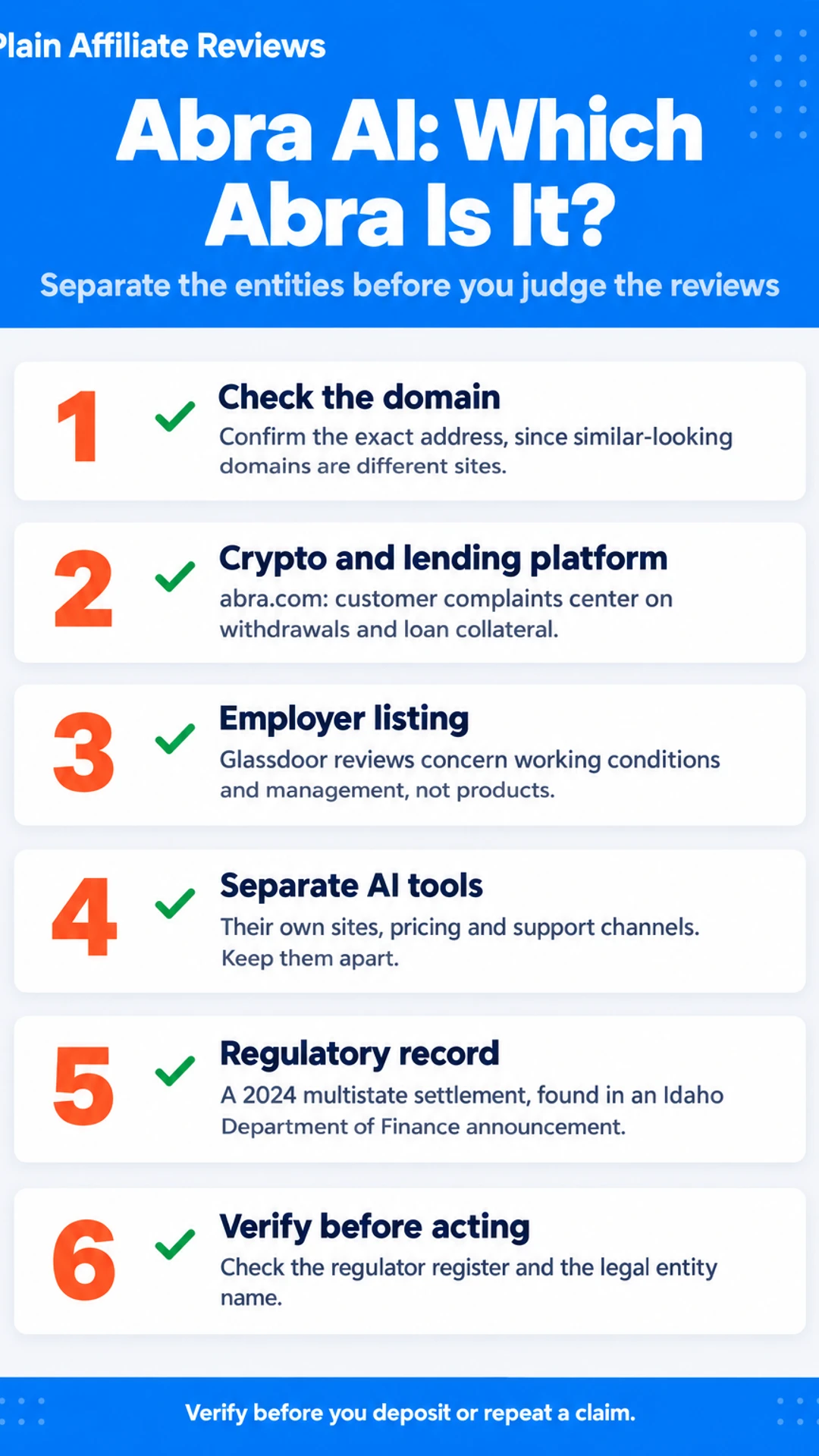
Searching for "abra ai com reviews and complaints" can pull up results for several companies that share the Abra name. They are not the same business, and a complaint about one says nothing about another. The entities that tend to appear include:
- The abra.com crypto and lending platform, a financial product where users can hold, trade or borrow against digital assets.
- An employer called Abra listed on Glassdoor, where the reviews are about working conditions and management, not any product.
- Separate AI tools and training products that use the Abra name, which may have their own sites, pricing and support channels.
Before you read any review or complaint, check three things. First, confirm the exact domain in the address bar, because a similar-looking domain is not the same site. Second, confirm the company name stated in the terms of service or footer. Third, look for the registered business name and jurisdiction, and check whether the review describes the same product you are looking at.
A useful habit is to ask what the review is actually about. If it mentions loan repayments, it belongs to the lending side. If it mentions a manager or a salary, it belongs to the employer side. Keeping those categories separate will save you from drawing conclusions the evidence does not support. Reviewers rarely name the product version they used, so a value like the account type or service tier can help you judge whether a complaint applies to your situation.
Three entities that share the Abra name
| Entity | What it is | Where reviews appear |
|---|---|---|
| abra.com | Crypto and lending platform | Customer complaints on Trustpilot |
| Abra employer listing | Employer, not a product | Glassdoor |
| Separate AI tools | AI and training products | Their own sites, pricing and support |
What Customers Complain About
Before you spend money on anything in this space, it helps to know what the people who already paid have said. For Abra AI, the public complaints cluster into a few themes, and the most useful thing you can do is look at how often each one shows up, not how dramatic the worst review is.
The most repeated theme on Trustpilot for abra.com concerns collateral. Several reviewers say their collateral was not returned after they repaid their loan. The wording varies, but the grievance is the same: the repayment was made and the asset did not come back. Treat this as a pattern worth checking, not a settled fact, because the reviews themselves do not show the full loan terms or the company's side of each case. Note the key terms in any loan agreement, such as the release conditions for collateral, before you assume the complaint applies to you.
Reviews of the AI product on the air.ai and aibusiness-lab.com pages raise different problems. The common ones are poor support response, bugs that make the product hard to use, and a general sense that the service does not match what was promised. Some reviewers have also questioned whether the company is legitimate at all. That is a serious claim, and it is one you should verify yourself before acting on it.
Keep the sample size in mind. On these sites, the number of reviews is often small, so one angry post can look like a trend when it is not. A pattern that repeats across many unrelated reviewers, such as the collateral complaints, carries more weight than a single extreme story. Look for the themes that keep appearing, and be cautious about any conclusion built on a handful of posts.
What the Public Record and Regulators Show
Before you weigh any Abra AI review or complaint, it helps to separate what regulators have formally found from what people say online. Those are very different kinds of evidence.
The most concrete item in the public record is an announcement from the Idaho Department of Finance. It reported that a multistate investigation found Abra operated a crypto buying, selling and investing app, and that the company settled the matter by agreeing to return funds to affected users. Check the announcement itself for the exact date, because that date is what anchors the finding in time. The text of the settlement and the named regulators involved will be in the same announcement or in the regulator's own filings.
A regulatory settlement is narrower than it sounds. It describes a finding against a specific legal entity, in a specific set of circumstances. It is not a general verdict on every product, app or service that uses the same name. If you see a page that says "Abra is a scam" with no reference to a particular settlement, treat that as opinion until you can link it to an actual document.
How do I check a firm myself?
Look up the firm in your country's financial regulator register. Most regulators publish a searchable register of licensed and registered firms. Search the legal name of the company, not just the brand, and read what activities the registration covers. Note the registration number and the date the record was last updated, so you can show what you checked and when.
A missing registration is worth checking, not assuming. It might mean the firm is unlicensed where you live, or it might mean it operates under a different entity name or from another jurisdiction. Either way, a register search is the quickest way to find out.
Published Claims Compared With Complaints
Before you spend money on anything tied to Abra AI, it helps to separate what the seller says from what independent sources actually show. The gaps matter as much as the claims.
The table below is how I read the material. Each row is marked confirmed, disputed or not verified. "Not verified" means the public sources I could find do not settle the claim either way.
- Ease of use: Published claims describe a simple, guided interface. Reviews that describe the user interface as straightforward exist, but they rarely say how long a beginner needed to get started. Mark: not verified.
- Support: Sellers point to responsive help. Complaints about slow or missing replies appear in public feedback, but I could not find a consistent record to weigh them against. Mark: disputed.
- Returns and refunds: Published refund terms are the claim to check against the actual policy page before you buy, since the wording is the thing that matters. Mark: not verified.
- Regulation: Some pages imply oversight or compliance. I found no regulator record that confirms this. Mark: not verified.
- AI performance: Claims about accuracy or profit from the tool are not backed by a named, independent test I could find. Mark: not verified.
Where a claim has no independent record behind it, I would treat it as marketing until a named source says otherwise. Ask the seller for documentation, and ask current users specific questions about their own results before you commit. A useful question is the exact amount you would need to deposit, and the exact time a withdrawal took, rather than general impressions.
Abra AI: claimed strengths and reported weaknesses
| Area | Published claim | Reported complaint |
|---|---|---|
| Ease of use | Simple, guided interface | Bugs and hard-to-use product reported |
| Support | Responsive help | Slow or missing replies reported |
| Returns and refunds | Stated refund terms | Not stated |
| Regulation | Implied oversight | No confirming regulator record found |
| AI performance | Accuracy or profit claims | No named independent test found |
How to Judge Reviews and Spot Weak Evidence
Before you give weight to any verdict on Abra AI, ask who gains if you believe it. Comparison and ranking sites often earn commissions when you click through and buy, so a "top pick" or "best overall" label may reflect a payout rather than a test. Treat those verdicts as a starting point and check them against primary sources: the company's own published terms, any regulator records you can find, and the complaints people have filed directly with a consumer body or payment provider.
Be careful with employee reviews too. A Glassdoor page can tell you how staff feel about hours, management or pay. It tells you nothing about whether the product works or whether customers are safe. Don't let a grumpy former employee stand in for evidence about the product.
Watch for patterns in the reviews themselves. If several posts share the same odd phrasing, the same structure or the same praise for the same features, that can point to a coordinated campaign rather than separate customers. A single reviewer with a distinct story carries more information than ten near-identical lines.
Short, unsourced claims deserve the least weight. A comment that says "scam" or "legit" with no description of what happened, what was paid, or what was promised, tells you almost nothing. Ask for the specifics. Where a claim names a charge, a date, a refund request or a support ticket, you have something you can check. Where it doesn't, you have an opinion.
A Practical Checklist Before You Deposit Money or Share Data
Public reviews of any product, including Abra AI, tend to tell you more about the reviewer than the product. The same process works whether you are looking at Abra AI, a paid affiliate course, or a free PDF, so it is worth doing before any money or personal data changes hands.
1. Check the regulator register for the exact legal entity. Most countries have a free public register for financial services or consumer-facing firms. Search for the company name on the official regulator site, not through a link on the seller's page. Confirm that the entity named in the terms is the one that is licensed, and read the licence scope. A licence to do one activity does not cover everything the marketing implies.
2. Read the withdrawal, collateral and fee terms in full. Find the sections on how and when you get money out, what fees apply, and whether any collateral or reserve is held back. Note the wording on dispute handling too. If a term is vague, write down the question and ask it in writing before you pay.
3. Test a small withdrawal before depositing a large sum. If the product lets you move money in and out, start with an amount you can afford to lose, such as a small fraction of what you plan to commit. Request a withdrawal and time how long it takes to arrive. This is a cheap test of the thing that matters most, and it gives you a real figure to compare against the stated timeline.
4. Search complaint boards for the specific problem you care about. Use search terms such as "withdrawal delayed" or "collateral not returned" rather than the brand name alone. Ignore the overall star rating, which can hide a few serious unresolved cases among many easy ones.
5. Record what is still unresolved. Keep a short list of open complaints, including collateral disputes, and whether the company has responded to them. Unresolved issues are more informative than a score.
What hands-on reviewers found
These are other people's hands-on tests, summarised and credited to them. Watch the full videos for their complete reviews.
NoBSIMReviews: Master Affiliate Profits Review - What You Need To Know!
The reviewer concludes that Master Affiliate Profits is not a scam and that experienced marketers with existing traffic can make money with it, but that its upgrade-to-earn structure makes it a high-risk pay-to-play model that resembles a p
- The reviewer says most public reviews of MAP are written by affiliates, and cites a Reddit review that reads as an AI-written sales pitch without explaining how the platform works. (at 1:14)
- The reviewer notes the MAP Hall of Fame leaderboard looks impressive, but most listed earners already have existing audiences to promote MAP to. (at 1:39)
- The reviewer says MAP is not a scam and that, with existing traffic, they could generate a lot of commissions by plugging it into their channels. (at 2:11)
The InBetween: Master Affiliate Profits Review - Is This System Legit?
Erica thinks Master Affiliate Profits is a training system with heavy upsells and a traffic-dependent income model she would not rely on, and she prefers her own digital leasing model.
- Says the training is simple and organized, which suits beginners, but several features stay locked unless the buyer upgrades. (at 1:14)
- Reports that the lower membership levels include basic training while most bigger features sit behind upgrades, with Platinum presented as the level that unlocks free traffic rotation. (at 2:04)
- Notes that online reviews mix praise for the organized training and lead ownership with complaints about constant upsell reminders, shallow training depth, weak traffic rotation and autoresponder compatibility. (at 3:16)
Frequently asked questions
Who owns Abra crypto?
Public sources I could check do not give a clear, verified answer to who owns Abra. Company registration records, official filings and the company's own statements are the places to look. Until a named owner is confirmed in one of those sources, treat any claim about ownership with caution, including claims repeated on review sites.
Are AI trading sites safe?
Safety depends on the specific site, so no general answer covers them all. Check whether the operator is registered with a financial regulator in your country, whether it holds customer funds in a clearly named account, and whether it publishes how returns are produced. Be wary of guaranteed returns, pressure to deposit more, and a lack of verifiable company details.
Is AI Acquisition a legit company?
I could not confirm from the sources I reviewed whether AI Acquisition is a legitimate company. Look for a registered business name, a physical address, named directors and independent reviews that do not depend on the company's own marketing. If those details are missing or hard to verify, that is a reason to hold off until you can check them.
Is Abra Electronics legit?
I did not find reliable public evidence either way on whether Abra Electronics is legitimate. Check its business registration in the country where it operates, look for a working address and customer service channel, and read complaints on independent consumer forums. Lack of information is not proof of a scam, but it does mean you should verify before paying.
What is a sensible first step when a company's claims and complaints do not match?
Write down the specific claims, such as returns, ownership or product features, and check each one against a primary source like a company registry, regulator database or official filing. Complaints that describe the same problem in many separate cases carry more weight than a single angry post. Where neither side can be confirmed, the honest answer is that the gap remains open.
Wrapping up
Published claims about Abra AI and the complaints about it do not line up cleanly, and in several areas neither side has been confirmed by an independent source. That gap matters more than any single review. Before you spend money, check the claims against registries and regulators yourself. Have you found a source that settles one of these questions? Share it in the comments.