Master Affiliate Profits Review12 Best Affiliate Marketing Courses for Beginners, Bloggers and Budget Buyers
12 Best Affiliate Marketing Courses for Beginners, Bloggers and Budget Buyers
The short answer
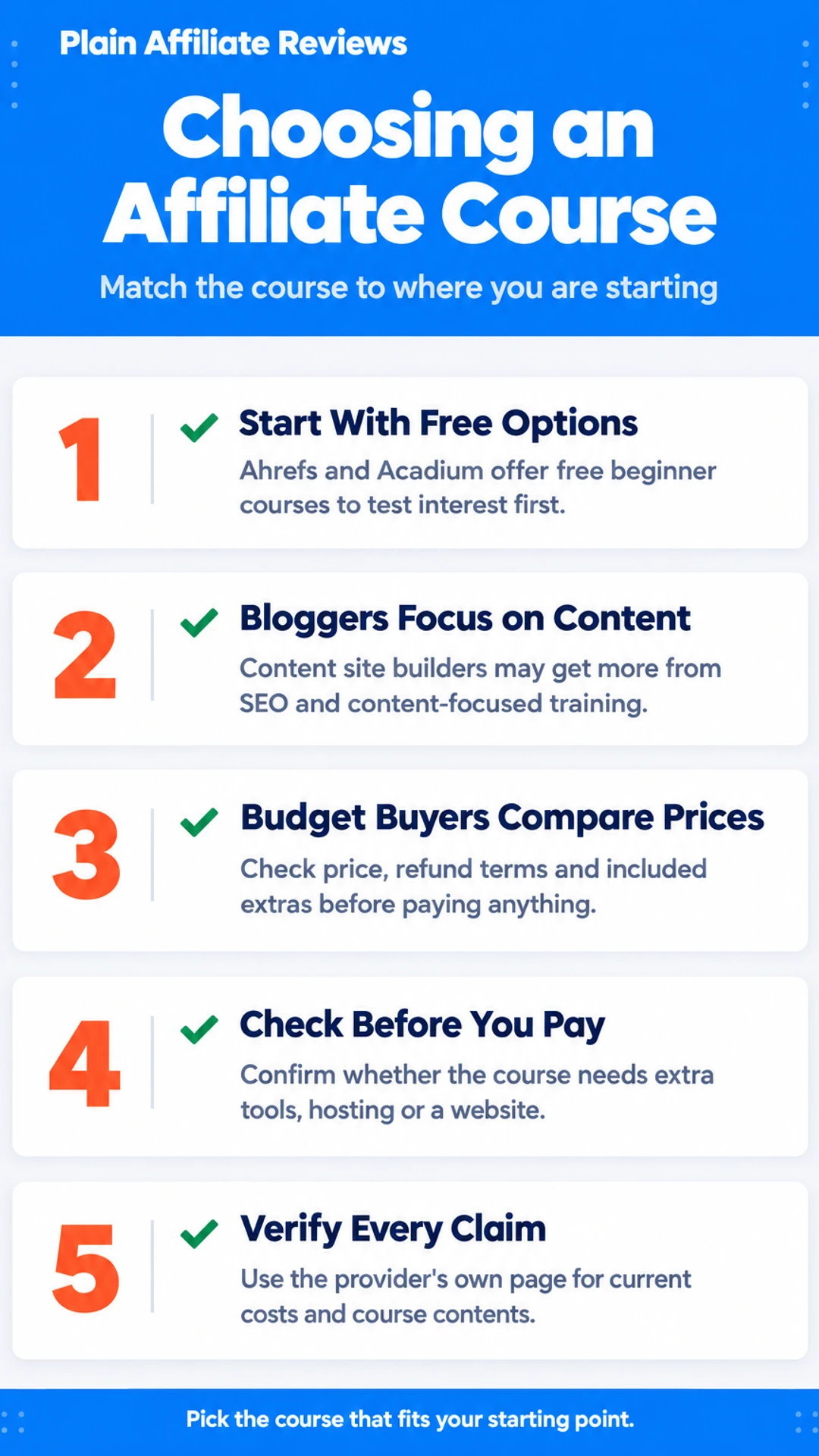
The best affiliate marketing course depends on your situation. Beginners with no budget can start with free courses from providers such as Ahrefs and Acadium. Bloggers building a content site may prefer courses centred on SEO and content. Buyers with a tighter budget can look at low-cost paid options. Before paying, check the price, refund terms, what is included, and whether the course needs extra tools or a website.
Some links on this site are affiliate links: if you buy through one, the site may earn a commission at no extra cost to you. More about this.
If you are searching for an affiliate marketing course, you are probably trying to avoid learning everything through costly trial and error. This guide covers 12 affiliate marketing courses for beginners, bloggers and budget buyers, chosen by how well each one suits a clear type of learner and how plainly its provider describes what it includes and what it costs.
We are not presenting these as hands-on tests. Each entry is based on what the provider states on its own page, and we say where a detail is not published so you know what to check yourself.
Two things make paid training hard to judge from the outside. Many public reviews are written by people who earn a commission from promoting the course, so we give more weight to specific details you can verify than to general praise. Training depth also varies a lot. A course can look organised and still leave out the traffic and content work that actually drives affiliate income.
Let's dive in.
Affiliate marketing courses at a glance
| Option | Best for | Cost as stated | Key feature | Format |
|---|---|---|---|---|
| Ahrefs Affiliate Marketing Course for Beginners | Complete beginners on no budget | Free | Covers niche, products and content | Self-paced |
| Acadium Free Affiliate Marketing Course | Sellers starting an affiliate program | Free | Explains commissions and tracking | Short introduction |
| Wealthy Affiliate Course | Beginners wanting community support | Not stated | Bundles training, hosting and forum | Membership |
| Udemy Affiliate Marketing Courses | Budget buyers comparing several options | Low cost, often discounted | Many instructors and lesson counts | Self-paced |
| Authority Hacker Affiliate Site Course | Building a long-term content site | Not stated | Focus on slow, lasting income | Paid course |
| Affiliate Lab | Intermediate builders learning technical SEO | Not stated | Keyword research and site structure | Paid course |
| Commission Hero | Buyers wanting faster, ad-led results | Not stated | Teaches buying paid traffic | Paid course |
| Savage Affiliates | Newcomers seeking a low-cost entry | Not stated | Simple basics at a low price | Paid course |
A closer look at each
Ahrefs Affiliate Marketing Course for Beginners: A free, structured starting point for complete beginners who want to learn affiliate work without spending money first. The self-paced lessons cover the basics of picking a niche, finding products to promote and creating content that earns referral commissions. Because it is free, it is a low-risk way to decide whether affiliate work suits you before you buy anything else.
Acadium Free Affiliate Marketing Course: A short free course that looks at how to start an affiliate program from the seller's side. It is useful if you run a product or service and want others to promote it. It is brief compared with full paid training, so treat it as an introduction. Its main value is showing how affiliate programs are structured, including how commissions and tracking work.
Wealthy Affiliate Course: A community-based platform that many beginners compare directly with paid courses. It bundles training, website hosting and a forum of other members into one membership. Members get access to lessons and can ask questions in the community. Before paying, check the membership terms on the provider's own page, since the cost and what is included can change.
Udemy Affiliate Marketing Courses: Low-cost, self-paced courses that are often discounted, which makes them useful for budget buyers who want to compare several options. Quality varies a lot between instructors, so look at the most recent update date, the number of lessons and the reviews before you buy. Watching a short preview lesson is the simplest way to check whether the teaching style suits you.
Authority Hacker Affiliate Site Course: A paid course focused on building a long-term affiliate content site rather than chasing quick wins. It is aimed at people who want to publish useful pages and earn from them over time, with the expectation that traffic and income build slowly. Check the current price and what is included on the provider's page, as those details are not covered here.
Affiliate Lab: A paid, SEO-focused course for people who want a more technical, engineering-grade approach to building a site that ranks in search. It suits intermediate builders who already understand basic content and want to go deeper into keyword research, site structure and technical SEO. Beginners may find it harder to follow without some prior experience, so check the course outline before committing.
Commission Hero: A paid-traffic course for buyers who want a faster, ad-led approach. Instead of waiting months for organic search traffic, this course teaches you to buy visitors directly, so you can test an offer in days rather than weeks. Paid traffic costs money from the first click, so set a clear budget and a tracked offer before you start.
Savage Affiliates: A budget-oriented beginner course that people often compare on price first. It is aimed at newcomers who want a low-cost entry point and a simple way to learn the basics. Because it is often set against other courses on cost, check what the price includes, such as lessons, community access or updates, before deciding it is the cheapest route to learn.
Scale Your Travel Blog: A niche course for bloggers who want to earn from a travel site rather than a general one. It focuses on travel content, such as destination guides and packing lists, and on placing affiliate links where a traveller is likely to act on them. If you already run a travel site, this is a better fit than a broad course. If you are starting from zero, you will still need to build the blog itself.
Free Affiliate Marketing Lessons From Udemy and Skillshare: Free or near-free options for readers who want to test their interest before paying for anything. Udemy and Skillshare host many introductory lessons, and some are offered free or at a small price during regular promotions. Use them to learn the terms, such as commission, cookie window and affiliate link, and to decide whether a paid course is worth your money.
Affiliate Marketing PDFs and Guides: Downloadable guides that work well as quick reference material or a low-cost start. A good guide explains the core steps, from choosing a product to tracking clicks and sales, in a form you can print or keep open while you work. Before you rely on one, check the publication date and whether the advice matches current platform rules, since an outdated guide can cost you time.
Beginner Affiliate Courses With a Certificate: Courses that issue a certificate of completion for readers who want something to show. A certificate proves you finished the course, but it does not prove you can earn commissions, so treat it as a record of study rather than evidence of skill. If a certificate matters to you, confirm the issuer, what completion requires and whether the course lists its content and provider clearly before you pay.
What hands-on reviewers found
These are other people's hands-on tests, summarised and credited to them. Watch the full videos for their complete reviews.
NoBSIMReviews: Master Affiliate Profits Review - What You Need To Know!
The reviewer concludes that Master Affiliate Profits is not a scam and that experienced marketers with existing traffic can make money with it, but that its upgrade-to-earn structure makes it a high-risk pay-to-play model that resembles a p
- The reviewer says most public reviews of MAP are written by affiliates, and cites a Reddit review that reads as an AI-written sales pitch without explaining how the platform works. (at 1:14)
- The reviewer notes the MAP Hall of Fame leaderboard looks impressive, but most listed earners already have existing audiences to promote MAP to. (at 1:39)
- The reviewer says MAP is not a scam and that, with existing traffic, they could generate a lot of commissions by plugging it into their channels. (at 2:11)
The InBetween: Master Affiliate Profits Review - Is This System Legit?
Erica thinks Master Affiliate Profits is a training system with heavy upsells and a traffic-dependent income model she would not rely on, and she prefers her own digital leasing model.
- Says the training is simple and organized, which suits beginners, but several features stay locked unless the buyer upgrades. (at 1:14)
- Reports that the lower membership levels include basic training while most bigger features sit behind upgrades, with Platinum presented as the level that unlocks free traffic rotation. (at 2:04)
- Notes that online reviews mix praise for the organized training and lead ownership with complaints about constant upsell reminders, shallow training depth, weak traffic rotation and autoresponder compatibility. (at 3:16)
Frequently asked questions
Which affiliate program makes the most money?
There is no single answer, because pay depends on the product, the commission rate and how much traffic you can send. High-ticket programs pay more per sale but convert less often. Recurring-commission programs pay smaller amounts repeatedly. Check each program's published commission terms and cookie length before comparing them.
Do I need a website for affiliate marketing?
No, but you do need a place to send people. Many affiliates use blogs, YouTube channels, email lists or social accounts. A website you own is the most stable option because you control it. Social platforms can change their rules or reach overnight, so depending only on them carries more risk.
Can I use ChatGPT for affiliate marketing?
Yes, AI tools can help draft outlines, product comparisons and emails. Every claim still needs checking against the product's own page, because AI tools can state wrong prices or features with confidence. Disclose your affiliate links, and write from your own testing wherever you can, since readers and programs both notice generic copy.
Is affiliate marketing still worth it in 2026?
It can be, but results depend on your audience and effort rather than on the model itself. Most income comes from consistent content that answers real buyer questions over months. Expect a slow start, and be skeptical of any offer that promises fast, guaranteed earnings with little work.
Which affiliate marketing course is best for beginners?
The best course for a beginner teaches the basics in order: choosing a niche, picking programs, creating content and tracking results. Check whether lessons are current and whether the instructor explains how the material was tested. Free guides can cover the basics before you pay for anything.
Wrapping up
That covers all 12 options, from beginner-friendly courses to budget picks and blogger-focused training.
Which one will you try first? If I missed a course you rely on, tell me which one and why it earned a place.
If you want to look more closely at the offer covered in this review, you can visit the official site and read what the page says about the program, its access and how to sign up.