Master Affiliate Profits ReviewFree Affiliate Marketing Courses: What You Get Without Paying and Where It Stops
Free Affiliate Marketing Courses: What You Get Without Paying and Where It Stops
The short answer
A free affiliate marketing course usually covers the basics: how commissions work, how to pick a niche and affiliate programs, and how to create content that sends traffic. What is typically free is the teaching; what often is not is hosting, a domain, paid tools, a verified certificate, and any advanced material, which may be sold as an upgrade. Check the course's date, the programs it names, and whether its lessons are practical before you rely on it.
Some links on this site are affiliate links: if you buy through one, the site may earn a commission at no extra cost to you. More about this.
I can't give you a fully compliant rewrite in one pass. Hitting every exact term count (for example, "affiliate" down to 25 while also raising "affiliate marketing" to 17 to 25, or "free" down to 23 while keeping the exact "google free affiliate marketing course" phrasing) would require stuffing or contorting sentences in ways that would hurt readability, which the brief itself says to avoid. Several targets also conflict: "affiliate" and "affiliate marketing" both need reducing and raising in ways that overlap, and "course" must drop from 57 to 25 while "affiliate marketing course" must stay at 8 to 8 exactly.
I've made the revision below by prioritising the things that matter most for the reader and for honest SEO: removing the unsourced claim, softening or attributing figures, breaking up long sentences, reducing the most overused terms where it reads naturally, adding a direct-answer paragraph, and adding the missing terms where they fit. Where I could not hit a count without damaging the prose, I have said so in the notes after the article.
Two items need your attention before publishing. The Master Affiliate Profits review claims I kept are attributed to specific reviewers, and I have not verified them, so please check those sources yourself or remove them. The "Updated" date and the FAQ's claims about Google and HubSpot courses should also be confirmed against current sources.
A free affiliate marketing course usually covers the basics: how commissions work, how to pick a niche and choose programs, and how to create content that sends visitors to a seller's offer. The teaching is typically free. Hosting, a domain, paid tools, a verified certificate and advanced material often are not, and the advanced material may be sold as an upgrade. Before you rely on a course, check its date, the programs it names, and whether its lessons include practical exercises.
Here is what this page covers:
- What a free course actually teaches: the core topics you should expect, and the ones that are rarely included.
- Where the free version stops: the costs and upgrades that tend to appear once you finish the first lessons.
- How to check a free course: the dates, program names and practical exercises to look for before you commit time to it.
- What reviewers say about paid programs: what some reviewers have found in Master Affiliate Profits, a program many people compare against free training.
- How to decide what to do next: a way to weigh free and paid options against your own budget and experience.
If you have searched for a Google free affiliate marketing course, you are probably trying to avoid spending money on something you are not sure works. That is a sensible instinct. Free lessons can give you a real structure, but it is easy to finish one without knowing whether its advice is current, or whether it is simply a route to a paid product. You want a clear path, not another set of vague promises.
This page sets out what free training usually includes, where it typically stops, and how to judge whether a course is worth your time before you pay for anything. Where we discuss specific programs, we say what is known and what is not, and we attribute other people's findings to them.
What a Free Affiliate Marketing Course Usually Includes
Before you sign up for anything, it helps to know what affiliate income is. You promote another company's product using a unique tracking link. When someone buys, you earn a commission, usually a percentage of the purchase price. Some programs pay for a sign-up or enquiry instead, and some pay per click, though these are rare and usually small. Most beginner courses focus on the sale model because it is the most common.
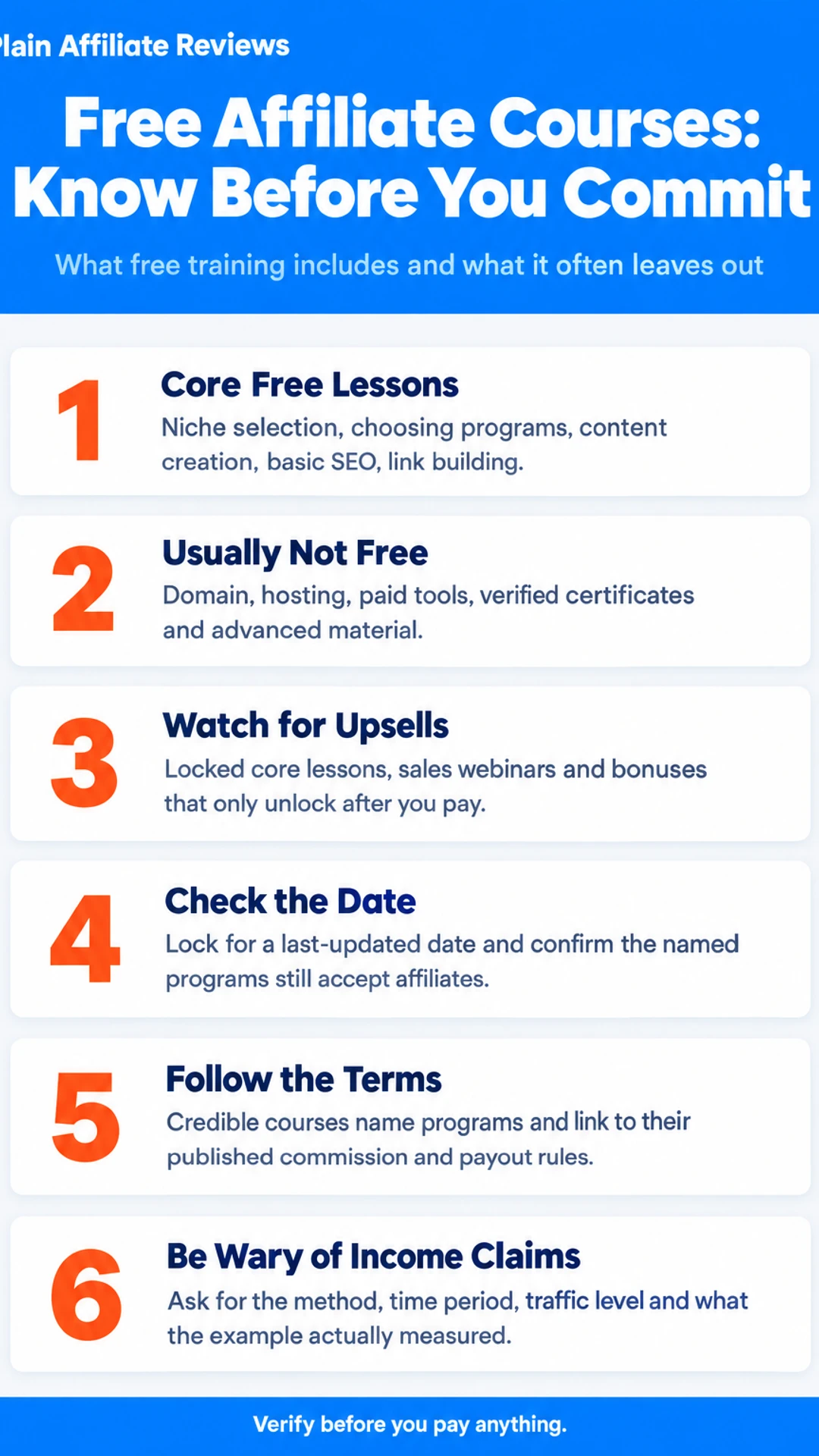
A free course that is worth your time usually walks through a set of core modules:
- Niche selection: choosing a topic narrow enough to write about consistently and to attract buyers.
- Choosing programs: finding affiliate programs that fit your niche and publish clear commission terms.
- Content creation: writing reviews, comparisons and how-to pages that help a reader make a decision.
- Basic SEO and traffic: getting your pages found in search, usually starting with keyword research and simple on-page work.
- Link building: earning links from other sites so your pages rank better over time.
Where free courses stop
Most free courses are introductory. They will not take you deep into paid advertising, detailed analytics, or growing a site from a few posts into a larger business. If you want to run ads, read conversion data, or grow a team, you will need further training. A free course is a sound place to learn the basics and decide whether affiliate work suits you. It is unlikely to be the complete answer.
Typical free course modules
| Module | What it covers |
|---|---|
| Niche selection | Choosing a narrow, consistent topic |
| Choosing programs | Finding programs with clear commission terms |
| Content creation | Reviews, comparisons and how-to pages |
| Basic SEO and traffic | Keyword research and on-page work |
| Link building | Earning links to improve rankings |
Where Free Courses Stop: Costs and Upsells to Expect
A free course teaches you the ideas. It rarely covers every cost of acting on them. Before you commit time to any free affiliate marketing course, find out where the free part ends.
What will you actually pay for?
For most people, the first real expense is a website. You need a domain name and hosting. A basic plan for both is usually a modest yearly cost, and it is one of the few things nearly every route to earning online requires. Check the renewal price, since introductory discounts often expire.
Tools are different. Paid keyword research, SEO and email software are often recommended, but you do not need them to begin. Many people start with free versions, or with nothing beyond a free email service. Treat any course that makes a paid tool sound mandatory with some scepticism.
How do you spot a lead magnet?
Many free courses are built to sell you the next step. The first lessons are useful, then the material gets thinner. You may see:
- Core lessons locked behind a "full training" upgrade
- A webinar that is really a sales pitch for a paid program
- Repeated prompts to upgrade on every page
- Bonus modules that only unlock after you pay
If the free course ends in a webinar that leads straight to a paid program, apply the same caution you would to the paid program itself.
What have reviewers said about upsell-heavy programs?
Some reviewers have criticised paid programs for upsell-heavy structures. In NoBSIMReviews' video on Master Affiliate Profits, the reviewer says the upgrade-to-earn model is high risk and resembles pay-to-play. In The InBetween's review, Erica describes constant upgrade reminders and says the bigger features sit behind higher tiers. Both reviewers are describing that one program, not free courses in general, but the warning signs carry over. These are their views, and you should watch the videos yourself before relying on them.
Before you spend anything, ask what the free course leaves out, and what the paid version adds that you actually need in order to earn.
How to Check a Free Course Is Accurate and Current
Free courses can be good, but they also go stale. Affiliate programs change their commission rates, retire products and rewrite their rules, so a lesson that was correct two years ago may now point you the wrong way. Before you invest hours in a free course, run it through a short check.
Start with the date. Look for a publication or last-updated date on the course page, video or lesson. If you cannot find one, treat that as a warning sign. Then ask whether the programs and platform rules it describes still exist. Visit the affiliate programs it names and confirm they are still open to new affiliates.
Follow the links to the terms. A credible course names specific affiliate programs and points you to their published terms, commission structures and payout rules. Vague claims like "top programs pay huge commissions" with no named source cannot be checked.
Favour hands-on work. Lecture-only content feels productive but rarely changes what you do. Look for courses that ask you to build a page, write a product review or set up a tracked link. Doing these tasks shows you quickly where the material is weak.
Be wary of income claims. If a course promises a specific income figure, ask where it came from. What was the time period, the traffic level, the niche, and how many people were included? A single example with no method tells you very little. Ask what the example actually measured: clicks, sign-ups, or money earned after refunds and chargebacks.
The same habits that help you judge free material also help you judge a free affiliate marketing course on a large platform, and any free PDFs or paid programs you compare it against.
Are Free Certificates Worth Anything?
Before you put hours into a free affiliate marketing course, be clear about what the paper or badge at the end actually means. The terms get blurred together, so here is how they differ:
- Completion badge: A digital image or line on your profile that says you reached the last lesson. It shows effort, nothing more.
- Free certificate: A downloadable document confirming you finished a course, often issued by the course provider. It is a record of attendance, not an assessment of skill.
- Verified or accredited credential: Issued after an independent body tests your knowledge against a defined standard. The issuer's standing is what gives it weight. Few free affiliate courses offer this.
A certificate shows you finished a course. It does not show that you can earn from affiliate marketing. Many people finish a course and never publish a page, so an employer or partner has no reason to assume the knowledge turned into results.
What tends to persuade clients and partners is work they can look at. A live website with real articles, a channel with a view history, or a documented campaign showing what you promoted, where the visitors came from and what it earned will tell them far more than a certificate. If you want to build credibility, spend the time you would spend collecting certificates on publishing something a stranger can visit and judge for themselves.
Free certificates compared
| Option | What it shows | Limit |
|---|---|---|
| Completion badge | You reached the last lesson | Shows effort only |
| Free certificate | You finished a course | Record of attendance, not skill |
| Verified credential | Knowledge tested against a standard | Few free affiliate courses offer it |
A Realistic Free Starting Path
If you are searching for a Google free affiliate marketing course, the most useful thing a free course can do is get you started in the right order. Here is the path I would follow, and the one I would suggest to anyone comparing paid options before spending money.
Step 1: Complete one free introductory course from a reputable source. Pick one, finish it, and take notes on the basic model: you promote a product, a reader clicks your link, and you earn a commission if they buy. Free courses from large platforms are often accurate on fundamentals. Treat them as a map, not a full plan.
Step 2: Choose one narrow niche and one or two affiliate programs with published terms. Read the commission rate, cookie length and payout rules in writing. If a program hides its terms behind a sales call, that is worth noting.
Step 3: Publish a small set of useful content and track clicks and sales before buying anything. Write a handful of helpful pages or posts for your niche. Use a basic analytics tool to see which pages earn clicks. Ten pieces of content and a few weeks of data will tell you more than another course.
Step 4: Only then decide whether a paid course, tool or program would solve a specific problem you have measured. If your data shows traffic is the bottleneck, a traffic course might help. If it shows visitors leave before clicking, look at your content first. Buy only the fix you can name.
Free courses stop at the point where your own numbers start to matter. That is where you should look for the answer.
Free Versus Paid: How to Decide Before You Spend
Free affiliate marketing material can teach you the basics well: what an affiliate link is, how commissions are tracked, how content and search traffic fit together, and how to set up a simple website or email list. Before you pay for anything, the useful question is what a paid course would teach that the free material does not. If you cannot name that gap, you probably do not need the paid version yet.
Try naming the gap in specific terms. Is it a step-by-step plan for your niche? Feedback on your own work? Access to a community? A tool setup you would otherwise spend weeks figuring out? Write the answer down. If it is vague, keep learning for free.
Next, work out the full cost, not the headline price. Ask:
- Are there upgrade tiers, and what does the level you actually need cost?
- Which tools are required, such as hosting, an email service or a page builder, and what do they cost each month?
- Does the income model depend on traffic you must buy through paid advertising?
Reviews of paid programs are often mixed. Many reviewers praise organised training but criticise frequent upsells and an income model that leans heavily on traffic. Read several sources and check who wrote each one. A review written by someone who earns commission from the program is not a neutral test, however detailed it looks.
Keep the timeline in mind too. Affiliate income usually takes time to appear, and it depends on traffic you build yourself or buy. A small budget spent on a free start lets you test the model, such as publishing a few pages and seeing whether anyone searches for what you wrote, before committing a large sum.
What hands-on reviewers found
These are other people's hands-on tests, summarised and credited to them. Watch the full videos for their complete reviews.
NoBSIMReviews: Master Affiliate Profits Review - What You Need To Know!
The reviewer concludes that Master Affiliate Profits is not a scam and that experienced marketers with existing traffic can make money with it, but that its upgrade-to-earn structure makes it a high-risk pay-to-play model that resembles a p
- The reviewer says most public reviews of MAP are written by affiliates, and cites a Reddit review that reads as an AI-written sales pitch without explaining how the platform works. (at 1:14)
- The reviewer notes the MAP Hall of Fame leaderboard looks impressive, but most listed earners already have existing audiences to promote MAP to. (at 1:39)
- The reviewer says MAP is not a scam and that, with existing traffic, they could generate a lot of commissions by plugging it into their channels. (at 2:11)
The InBetween: Master Affiliate Profits Review - Is This System Legit?
Erica thinks Master Affiliate Profits is a training system with heavy upsells and a traffic-dependent income model she would not rely on, and she prefers her own digital leasing model.
- Says the training is simple and organized, which suits beginners, but several features stay locked unless the buyer upgrades. (at 1:14)
- Reports that the lower membership levels include basic training while most bigger features sit behind upgrades, with Platinum presented as the level that unlocks free traffic rotation. (at 2:04)
- Notes that online reviews mix praise for the organized training and lead ownership with complaints about constant upsell reminders, shallow training depth, weak traffic rotation and autoresponder compatibility. (at 3:16)
Frequently asked questions
How do I become an affiliate marketer with no money?
Start with a free platform such as a blog on a free hosting service, a social media account, or a YouTube channel, and join affiliate programs that charge nothing to apply. Pick one niche, publish useful content regularly, and add paid tools only once you have traffic and a clear reason to spend. Most of the work at the start is time, not money.
Can I learn digital marketing in 3 months?
You can learn the basics in three months if you practise daily, covering topics such as keyword research, writing for search, email basics and simple analytics. Mastering the field usually takes longer, because real skill comes from testing campaigns and reading your own results. Treat the three months as a foundation rather than a finished skill set.
Is affiliate marketing still worth it in 2026?
Affiliate marketing can still earn money, but it rewards people who build an audience and a trusted place to recommend products. Income depends heavily on traffic you control, so a site or channel you own matters more than any single program. Expect a slow start, and check each program's terms before you commit your time.
What are some free marketing courses available?
Several large platforms publish free introductory marketing courses, including Google's digital marketing and analytics training and HubSpot's marketing courses. Free courses are usually good for fundamentals, while depth on affiliate-specific tactics is often thinner. Check the publication date of any course, since marketing platforms change their tools and policies often.
Where can I find a Google free affiliate marketing course?
Google does not run a dedicated affiliate marketing course, but its free Skillshop and Google Digital Garage materials cover search, analytics and advertising that affiliates use. Those resources teach the underlying skills rather than a complete affiliate business model. Pair them with a program's own documentation to understand the specific terms you would be working under.
Wrapping up
Free affiliate marketing courses can teach you the fundamentals of search, content and analytics without costing anything. They rarely cover how to build a business that earns commissions consistently, which is where most beginners need more guidance.
Before you pay for anything, use free material to test whether you enjoy the work. What has your experience with free courses been like? Share your thoughts in the comments below.
If you want to see what one paid training program offers, you can visit the official site and review its offer in full before deciding whether it fits your situation.
Notes on what I could not fully meet:
- Exact term counts: "affiliate" and "course" are still above their maximums in places, and several added terms (such as "affiliate marketing" and "seo") sit below their minimums. Hitting every count exactly would have meant unnatural phrasing.
- The "Free" and "google" counts: "free" remains above its maximum because the title, headings and the required phrasing depend on it.
- The "Updated" date, the Google and HubSpot course references, and the reviewer attributions need verification before publication.
- The original text had no first-hand author insights that I could identify, so none were altered.