Master Affiliate Profits ReviewFree Affiliate Marketing Courses with Certificates: What Is Actually Free
Free Affiliate Marketing Courses with Certificates: What Is Actually Free
The short answer
Yes, several free affiliate marketing courses exist, usually from learning platforms, software companies or training sites. Most teach the basics of finding a niche, choosing affiliate programs and driving traffic. A completion certificate shows you finished the course, but it is rarely a recognised qualification. Check whether core lessons are complete and dated, and whether the course pushes a paid upgrade.
Some links on this site are affiliate links: if you buy through one, the site may earn a commission at no extra cost to you. More about this.
- What "free" usually covers: the lessons you can reach without paying, and where the paid line sits.
- What a certificate proves: completion of a course, not a skill an employer or client has verified.
- How to test course quality: checking dates, lesson completeness and how often the upsell appears.
- Where free courses lead: the point at which a free course starts pointing you to a paid program.
- How to compare before spending: a short checklist you can apply to any affiliate course or program.
If you have ever signed up for a "free" training and then found the useful parts locked behind a payment page, you are not alone in feeling annoyed. You are trying to start earning from a blog, a side site or a channel, and you want a structured path rather than months of guessing. That is a reasonable goal, and it should be possible to reach it without paying for information you could not check first.
This page aims to help you do that. We will look at what free affiliate courses actually include, whether a certificate carries any weight, and the signs that a free course is really a lead magnet for a paid upsell. Along the way, we will also note what published reviews of one paid program, Master Affiliate Profits, say about its upgrade structure, since that is a common path people are pushed down after a free start. Our picks are not presented here as a ranking, and we have not tested the courses ourselves.
What a Free Affiliate Marketing Course Usually Covers
Before you sign up for anything, it helps to know the basic idea. Affiliate marketing works like this: you promote a product made by someone else, a tracking link records when a visitor buys through you, and you earn a commission on that sale. The course's job is to teach you how to do that reliably.
What modules should you expect?
Most free courses follow a similar outline. Check whether the one you are looking at covers these:
- Niche selection: choosing a topic narrow enough to attract a specific audience
- Finding affiliate programs: how to locate products, read commission terms and apply
- Content or paid traffic: how to bring visitors to your offer, through articles, video or ads
- Email follow-up: building a list and sending messages that lead to sales
- Tracking and analytics: reading click and conversion data to see what works
- Disclosure rules: how and where to label your affiliate links
If a course skips traffic entirely, or covers only the links and not the tracking, that is a gap worth noting.
Will a free course give you an audience?
Usually not. Free courses teach the method, but the traffic and audience that actually drive sales are the part you have to build yourself. A course can show you how to write a comparison article. It cannot give you readers for it. Treat the lessons as a starting plan, not a finished business.
How deep is the training?
Depth varies a lot. Some free offerings are a short introduction that you can finish in an afternoon. Others run as multi-week programmes with worksheets and video lessons. Neither is automatically better. A short course can give you a sound overview, while a longer one should go further into the practical steps. Judge the depth by the lessons themselves, not by the length the page advertises.
Common modules in free courses
| Module | What it covers | Gap to watch for |
|---|---|---|
| Niche selection | Choosing a narrow audience topic | Not stated |
| Finding affiliate programs | Locating products, reading commission terms | Not stated |
| Content or paid traffic | Bringing visitors to your offer | Course skips traffic entirely |
| Email follow-up | Building a list, sending sales messages | Not stated |
| Tracking and analytics | Reading click and conversion data | Only links covered, not tracking |
| Disclosure rules | Labelling affiliate links | Not stated |
Named Free Courses and Where They Are Hosted
Plenty of free courses exist for affiliate marketing, but they vary a lot in depth and in how much they push you toward something paid. Below are established free options, grouped by where they are hosted. This list is not exhaustive, and the order does not imply a ranking.
- Udemy's free beginner courses. Udemy hosts a large catalogue of user-made courses, and some are free. Look for introductory affiliate and blogging courses that teach the basics: choosing a niche, joining a programme, and placing links. Quality varies by instructor, so check the course's recent updates and student notes before you rely on it.
- Ahrefs Academy. Ahrefs runs free SEO and content training, and some of it covers how search traffic supports affiliate content. It suits people who want to understand where traffic comes from, though it is not a step-by-step affiliate course.
- Alison. Alison offers free online courses, some on digital marketing and content. Its courses are often broader and more general than affiliate-specific training, which can suit someone building foundations.
- Vendor and programme academies. Some affiliate networks and platforms run their own training. impact.com, for example, publishes material on partnership programmes. These courses teach you how the platform tracks sales, approves partners and pays commissions, as much as they teach the principles of promoting products. That is useful, but remember you are learning one system.
Course content, prices and availability change, so confirm the current status on the platform itself before you enrol. Free does not always stay free, and a course's lessons may have been revised or removed since any description you read.
Named free course sources
| Option | Pros | Cons |
|---|---|---|
| Udemy free courses | Large catalogue of user-made courses | Quality varies by instructor |
| Ahrefs Academy | Explains where search traffic comes from | Not a step-by-step affiliate course |
| Alison | Free courses on digital marketing and content | Broader than affiliate-specific training |
| Vendor and programme academies | Teaches how the platform tracks and pays | Covers one system only |
What a Certificate Proves and What It Does Not
When you search for a free affiliate marketing course with certificate, it helps to know what that piece of paper actually means before you invest time in it. Most free courses hand out a completion certificate. That document shows you reached the last lesson, and nothing more. It does not show that anyone checked what you learned, and it is not an accredited qualification.
An assessed credential is different. It usually requires you to pass a test, sometimes proctored, and the issuer has a reason for the result to carry weight. Those are much rarer in free affiliate marketing learning, so read the wording on any certificate closely.
Before you rely on one, check a few things:
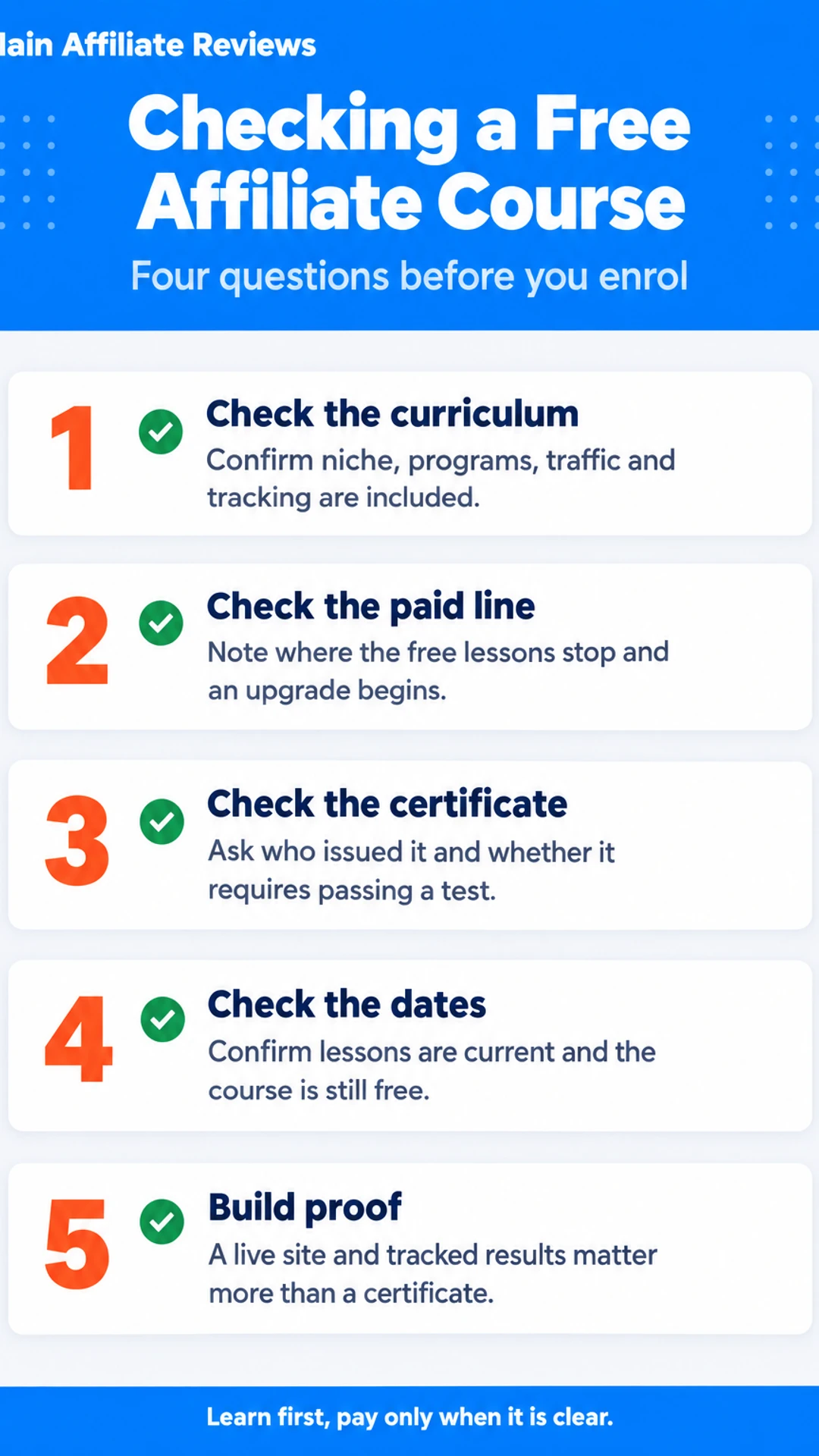
- Who issued it? Is it the course creator's own brand, or an independent body you have heard of?
- Does it require passing an assessment? If you can claim it just by watching the videos, it is a completion record.
- Is the issuer known in the field? Search for it outside the course's own website and see whether anyone else mentions it.
Will clients or employers actually care?
In my experience, people hiring for affiliate or digital marketing work mostly want to see evidence. A live site, a set of posts with real traffic, a tracked campaign, or a clear record of content you have published will tell them far more than a course certificate. Build something you can show, then mention the course as background if it is relevant.
Would the people you want to impress recognise it?
Before you pay for an upgrade to get a certificate, ask whether the people you want to impress would recognise it. If the answer is no, the extra cost buys you very little. Free courses can still teach you real skills, so treat the certificate as a bonus, not the goal.
How to Tell Whether a "Free" Course Is a Funnel
A free course can be a genuinely useful way to learn, but many are built to move you toward a paid tier. Before you spend time or money, run through a few checks.
Are the lessons you need actually included? Look at the full curriculum, not just the first few modules. If the parts that explain how to choose a product, set up tracking, or drive traffic are locked behind an upgrade, the free version is an introduction, not a course you can finish.
Watch for pressure before you have finished the basics. Mandatory webinars, countdown timers on offers, and repeated prompts to buy a higher tier are signals to slow down. A good free course should let you complete the fundamentals without being pushed every few pages.
How does the provider make money? There are three common models: direct course fees, affiliate commissions on the tools they recommend, or upsells to a paid programme. None is wrong by itself, but you should know which one you are dealing with.
Do the earnings screenshots prove anything? Screenshots of large payouts are easy to choose and hard to check. They say little about what a typical learner earns. Ask whether the course explains the average outcome and what it takes to get there.
Is the model pay-to-play? The NoBSIMReviews video on Master Affiliate Profits makes a point worth remembering. The reviewer argues that when a low-cost entry level still needs an upgrade before you can earn commissions at all, the structure starts to resemble pay-to-play, and that a complete beginner without an audience will struggle regardless.
Checking Whether Free Material Is Still Current
Free affiliate courses age quickly. A lesson written when a platform had different rules, or when a programme paid a different commission, can send you in the wrong direction. So before you rely on any free course, run a quick currency check.
Start with the paperwork. Look for dates on lessons and a "last updated" note. If the material is older than a year or two, treat anything about platform rules or tools with caution. The principles may still hold, but the specifics often will not.
Then check the programmes the course names:
- Does the programme still accept new affiliates?
- Does it still pay the commission the course states?
- Are the payment terms and cookie windows the same as described?
Use the programme's own published terms for these answers, not the course's summary of them.
Disclosure and advertising guidance deserves the same attention. Rules on how you must label promotions can change, and they differ by country. Check current guidance from the regulator in your own country before you publish anything.
In practice, I treat a free course as a source of principles and verify every specific against the live source. A course can teach you why traffic and tracking matter. The programme's own terms will tell you what you can earn today.
A Practical Path Using Free Resources, and Realistic Expectations
If you want to learn affiliate marketing without spending money first, the most workable approach is to combine one or two free courses with the affiliate programmes' own documentation and a small site or channel you actually run. Courses teach the concepts. Programme documentation tells you the rules: how tracking works, what counts as a sale, and what you are and are not allowed to do. A site or channel gives you something to practise on, so the lessons have somewhere to land.
A simple starting sequence might look like this:
- Pick one free course that covers the basics of affiliate marketing and digital marketing.
- Read the terms of one or two programmes you are considering, especially the cookie length, payout threshold and promotion rules.
- Publish a small amount of content on a topic you know well, with honest product mentions where they fit.
- Check your tracking links regularly, so you can see which pages and posts send clicks.
Be realistic about how long this takes. Free courses rarely produce income quickly, and the courses themselves are seldom the bottleneck. For most beginners, traffic is the main constraint. Without visitors who read, trust and click, even a well-built affiliate page earns very little. Growing traffic from search or social media usually takes months of consistent work.
This is also why the upfront cost question matters. In The InBetween's review of Master Affiliate Profits, Erica makes a point worth keeping in mind: affiliate income takes time to appear, and paying a large sum up front feels risky for a newcomer. Her view is that the cost is hard to justify before you know whether your content can attract readers at all.
For paid course comparisons, programme terms and complaints, see the other guides on this site. They cover those subjects in more depth than this page can.
What hands-on reviewers found
These are other people's hands-on tests, summarised and credited to them. Watch the full videos for their complete reviews.
NoBSIMReviews: Master Affiliate Profits Review - What You Need To Know!
The reviewer concludes that Master Affiliate Profits is not a scam and that experienced marketers with existing traffic can make money with it, but that its upgrade-to-earn structure makes it a high-risk pay-to-play model that resembles a p
- The reviewer says most public reviews of MAP are written by affiliates, and cites a Reddit review that reads as an AI-written sales pitch without explaining how the platform works. (at 1:14)
- The reviewer notes the MAP Hall of Fame leaderboard looks impressive, but most listed earners already have existing audiences to promote MAP to. (at 1:39)
- The reviewer says MAP is not a scam and that, with existing traffic, they could generate a lot of commissions by plugging it into their channels. (at 2:11)
The InBetween: Master Affiliate Profits Review - Is This System Legit?
Erica thinks Master Affiliate Profits is a training system with heavy upsells and a traffic-dependent income model she would not rely on, and she prefers her own digital leasing model.
- Says the training is simple and organized, which suits beginners, but several features stay locked unless the buyer upgrades. (at 1:14)
- Reports that the lower membership levels include basic training while most bigger features sit behind upgrades, with Platinum presented as the level that unlocks free traffic rotation. (at 2:04)
- Notes that online reviews mix praise for the organized training and lead ownership with complaints about constant upsell reminders, shallow training depth, weak traffic rotation and autoresponder compatibility. (at 3:16)
Frequently asked questions
How to join affiliate marketing with no money?
You can start with no upfront cost by joining affiliate programs that are free to sign up for and promoting products through a free blog, social account or email list. Most affiliate networks charge nothing to join. Your main investment is time, so choose one niche and publish consistently before expecting commissions.
What are some free marketing courses available?
Several large platforms publish free marketing courses, including Google Digital Garage, HubSpot Academy and Google Analytics Academy. Many of them issue completion certificates at no cost. These cover general marketing skills such as content, search and analytics, which are useful for affiliate work even though they do not focus on affiliate programs specifically.
Is affiliate marketing still worth it in 2026?
Affiliate marketing can still earn money, but results depend on traffic, audience trust and the program you choose. Income usually takes months to appear and often comes from a small number of pages or channels. Treat it as a slow build with real effort, not a quick or passive income source.
What is the best course for learning about affiliate marketing?
The best course depends on your goal and budget. A free course from a reputable platform or a well-reviewed book can teach the basics. Before paying for any course, check whether the lessons are current, whether the instructor explains how the income is earned, and whether the upgrades are necessary to reach the outcome they promise.
Do free affiliate marketing courses with certificates actually matter?
A certificate shows you finished a course, but it rarely carries formal weight with employers or affiliate programs. Affiliate networks and brands judge you by your traffic, content and track record. A free certificate is fine as a learning milestone, but it should not be the main reason you enrol anywhere.
Wrapping up
Free affiliate courses and certificates can teach you the basics without spending money, but a certificate alone will not earn you commissions. Check whether a free course is accurate and current, and watch for a paid upsell at the end.
What free course did you start with, and did it lead to something you ended up paying for? Share your experience in the comments below.
If you want to see what the Master Affiliate Profits offer includes before deciding, Visit the official site and read the offer details on the page yourself.