Master Affiliate Profits ReviewAI Business Lab Reviews and Complaints: What Public Feedback Says and Who Is Writing It
AI Business Lab Reviews and Complaints: What Public Feedback Says and Who Is Writing It
The short answer
Public feedback on AI Business Lab is mixed and comes from very different sources. Some reviews are written by affiliates who earn commission from promoting it, some come from independent buyers, and some are unclear. Before weighing any review, check who wrote it, whether they earn from a referral, and whether the review platform invites customers. This page sorts the feedback by source and gives a checklist for judging it yourself.
Some links on this site are affiliate links: if you buy through one, the site may earn a commission at no extra cost to you. More about this.
- Who is writing the reviews: how affiliate promoters, independent buyers and unclear authors differ in what they are likely to say.
- Where the praise and complaints come from: the recurring themes in public feedback, and which ones come from people with a financial stake.
- What a reviewer should disclose: the signs that a review is a sales pitch rather than a report of experience.
- A checklist for judging any review: the questions to ask about author, incentive, platform and specifics before you trust a claim.
- What public feedback cannot tell you: the limits of reviews when it comes to results, income and course quality.
If you are comparing affiliate courses before spending money, you have probably noticed that most reviews sound either glowing or furious, and rarely tell you much about the product itself. That makes it hard to decide whether a paid program is worth the money. The aim here is to give you a clearer way to read what is out there, so you can separate useful signals from noise before you commit anything.
We will not test AI Business Lab in this article. Instead, we will look at what people say about it, who is saying it, and why their incentives matter. For a full look at what the product includes and costs, see our main Master Affiliate Profits Review, and for the reviews specific to that program, see Master Affiliate Profits Reviews: What Public Reviews Say and Who Writes Them.
Where the Public Feedback on AI Business Lab Appears
When you look into AI Business Lab, you will find opinions in several places, and each one tells you something different. Knowing where a piece of feedback comes from is the first step to judging how much weight it deserves.
Here are the main places people post about it:
- Review sites such as Trustpilot, where anyone can leave a star rating and text.
- Facebook groups for bloggers and side-project builders, where members share experiences and recommendations.
- Reddit threads, which can be candid but are often started by people with a stake in the outcome.
- YouTube reviews, which range from careful walkthroughs to sponsored sales videos.
- Instagram posts, usually short, polished and built around income screenshots.
- Third-party trust-check sites that give a score or verdict based on a set of checks.
Each source collects opinions differently and has its own incentives. A review site invites anyone to post, so it captures many unhappy and happy customers, though it is easy to game. A Facebook group or Reddit thread may be full of affiliates who earn when people sign up, and that can shape what gets said. YouTube and Instagram creators often earn from the product they cover, which you should keep in mind when you watch.
Pay attention to review count, too. A glowing score from twelve reviews on one platform tells you much less than a mixed score from several hundred. Small samples swing easily.
Some trust-check pages reach their verdicts from automated signals, such as domain age, page structure or keyword patterns. Those signals describe the website, not the experience of a buyer. Treat them as one clue among many, not as a measure of how the product works for real users.
Separating Affiliate Promoters From Independent Buyers
Before you weigh any review of AI Business Lab, ask one question: does the person gain money if you buy? Many reviewers earn an affiliate commission, which means they receive a percentage of each sale made through their link. That gives them a direct reason to praise the product, and it does not automatically make their praise false, but it means you should read the review as a sales argument rather than a neutral report.
Some signals point toward promotion:
- A referral or tracking link, often with a code or an "exclusive" bonus attached
- A call to join "through my link" or to "click below" before any other detail is given
- Identical phrasing across many posts, videos or accounts, especially the same headline style or the same list of benefits
- Praise that never mentions a specific feature, a specific day, or anything that went wrong
Signals of an independent buyer look different. A buyer usually describes what they actually purchased, which tier or module, what they used it for, and what happened afterward. A useful review mentions something that went wrong or right in concrete terms, so you can check it yourself.
A reviewer can be both a buyer and an affiliate. What matters is disclosure. When someone says they earn commission from a link, you can discount their enthusiasm accordingly and still learn from their specifics. When they do not say, treat the review with more caution, and check the product's own published terms against what they claim.
What Positive Feedback Tends to Say, and What Sits Behind It
Most of the praise you will find for AI Business Lab falls into a few recurring themes. The question to ask of each is simple: would this reviewer have said it even without a reason to push the product?
- Organised training. Reviewers often say the lessons are clear and well ordered. This is one of the easier claims to check yourself, since you can judge the structure from a free preview or the published outline. Ask whether the reviewer is describing lessons they actually went through.
- Community access. Praise for a community is common. Look at who is doing the praising. If the reviewer sells the same product, a friendly community is part of their pitch.
- Ease of use. Comments about a simple dashboard are often sincere, but they say little about whether the tools lead to income.
The biggest caution is the earnings screenshot and the leaderboard. A screenshot shows that someone earned money, but not how many people started, how long they took, or whether they already had an email list or audience before they joined. Those are the details that decide whether the result is repeatable for you.
Watch for reviews that never describe the product in any detail. A post that talks only about how much the writer loves it, without naming a lesson, a tool or a feature, is usually not a real account of the product. Treat it as an opinion, not evidence.
Common praise and the caution attached to each
| Praise theme | Caution to check |
|---|---|
| Organised training | Did the reviewer actually complete the lessons |
| Community access | Is the reviewer also selling the same product |
| Ease of use | Says little about whether tools lead to income |
| Earnings screenshots | Start numbers, time taken and prior audience not shown |
What Complaints Say, and How to Check Them
Complaints about AI Business Lab tend to fall into a few themes. The most common ones are upsell pressure, difficulty getting refunds, and results that did not match what the buyer expected. Sort what you read into these buckets before you decide how much weight to give any single post.
- Upsell pressure: repeated offers to move up to a higher tier after you have already paid
- Refunds: requests that were slow, refused, or hard to find the policy for
- Results: claims of income or traffic that the buyer did not reach
Next, look at how specific each complaint is. A post that names the plan purchased, the date, the steps taken, and what the support team replied is far more credible than one that says "total scam." Specific detail is easy to check and hard to invent. Vague anger is not useful evidence either way.
Check whether the company answered complaints where they were posted. A reply that addresses the actual issue, on the same platform, tells you more than silence or a generic copy-pasted line.
Also remember that a complaint can be real and still reflect a mismatch. Someone with no audience, no email list, and no plan for getting traffic may simply have bought a product aimed at people who already have those things. The complaint is genuine, but the fit was wrong. Ask yourself whether the reviewer's situation resembles the one the product was built for.
Complaint themes and what to verify
| Complaint theme | What it describes | How to check it |
|---|---|---|
| Upsell pressure | Offers to upgrade after payment | Compare published tiers and whether upgrades are required |
| Refunds | Slow, refused or hard-to-find requests | Copy the refund policy and any conditions |
| Results | Income or traffic not reached | Ask whether the buyer's situation fits the product |
How Trust-Check Scores and Ratings Should Be Read
A star rating looks like a verdict, but it is a summary of however many people chose to leave a review. Before you give it weight, ask how many people were invited to review and how many actually did. A product with 4.6 stars from 12 reviewers tells you much less than the same score from 1,200. People who bought a program and felt neutral often say nothing, so the people who do speak tend to be the very happy or the very annoyed.
Trust-check sites deserve the same scrutiny. Many combine website signals such as domain age, hosting location, whether an https certificate is in place, and whether a privacy policy exists. Those signals can tell you something about a site's basic setup, but they do not measure whether the product works, whether the training is accurate, or whether the payouts are fair. A brand-new site can run a sound program, and an old site can be a poor one.
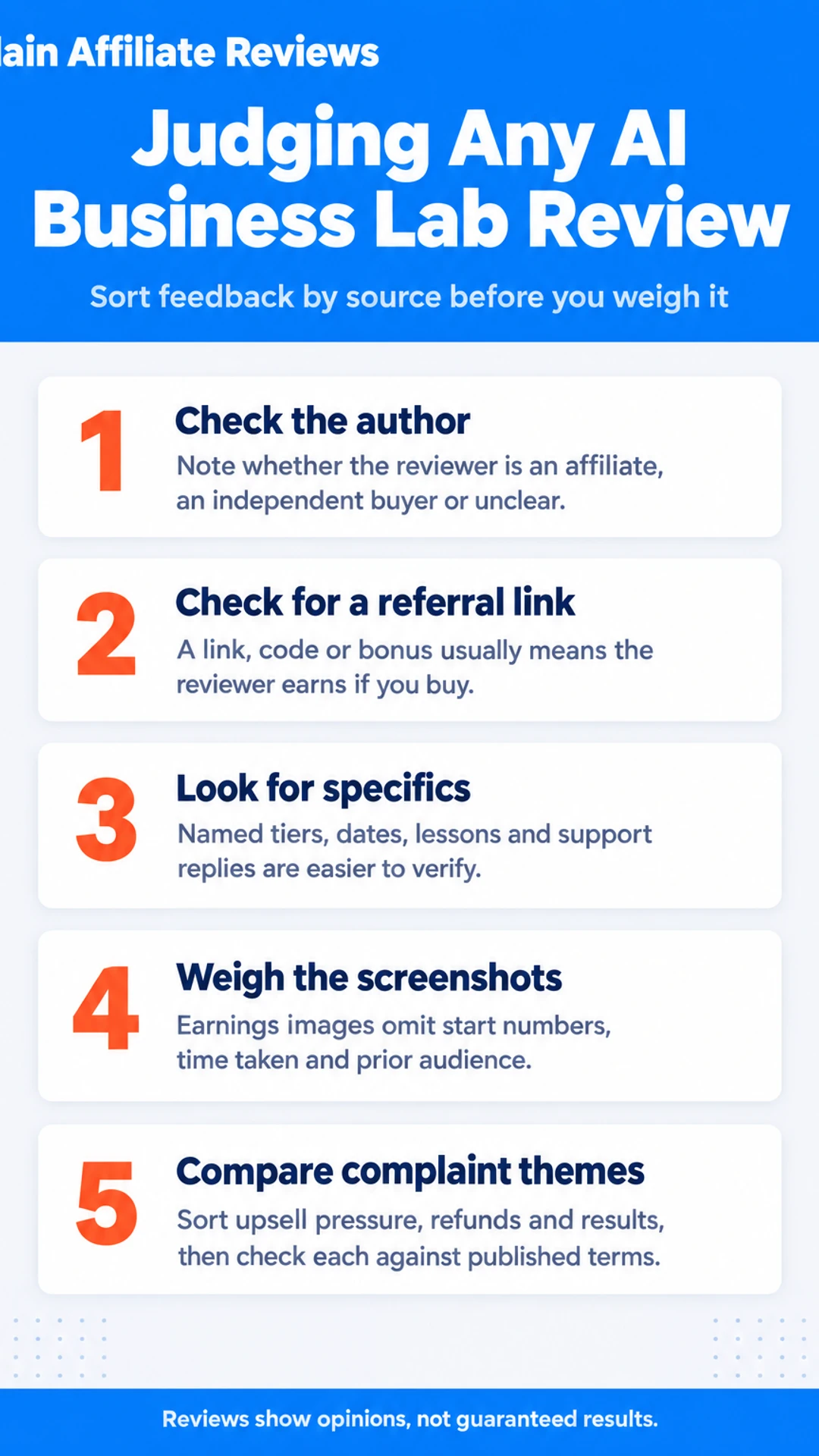
When a score or verdict is in front of you, read the written reviews behind it. Look for:
- Who wrote the review, and whether they link to a commission or sell the same thing
- Whether the review describes what happened, such as specific lessons, sign-up steps, or payment timing
- Whether the complaints point to the same problem over and over
- Whether the praise is vague and sounds like a sales pitch
A score from one site is one input, not a final answer. Compare it with written accounts from several independent sources before you decide.
What Public Feedback Cannot Tell You, and How to Verify Before Buying
This page does not test AI Business Lab, and it does not verify any claim the company makes about its training, tools, earnings or results. We have not bought or used the product, and what follows is a sorting of what other people have said publicly. Treat it as a map of the conversation, not a verdict.
Public feedback also has a source problem. Affiliates who earn commissions by promoting a product have a reason to write positive reviews, and some reviews read like sales copy. Independent buyers may be unhappy for reasons that have nothing to do with the product, or happy for reasons that will not carry over to you. A review is one person's experience on one day, not a guarantee.
Before you pay, work through these steps:
- Read the official site and copy out the exact terms, refund policy, pricing and contact details, including any conditions attached to a refund.
- Compare those published terms with what reviewers describe. Where they disagree, note the gap and ask about it.
- Email the company and ask for written answers to specific questions: what the refund window is, what you get at each price, whether upgrades are required, and what support you can expect.
- Keep the written answers. A reply you can point to is worth more than a verbal promise.
Be especially careful with income claims tied to AI tools. Results depend heavily on your available time, existing skills and the market you work in. No review, testimonial or leaderboard can promise you will earn anything.
What hands-on reviewers found
These are other people's hands-on tests, summarised and credited to them. Watch the full videos for their complete reviews.
NoBSIMReviews: Master Affiliate Profits Review - What You Need To Know!
The reviewer concludes that Master Affiliate Profits is not a scam and that experienced marketers with existing traffic can make money with it, but that its upgrade-to-earn structure makes it a high-risk pay-to-play model that resembles a p
- The reviewer says most public reviews of MAP are written by affiliates, and cites a Reddit review that reads as an AI-written sales pitch without explaining how the platform works. (at 1:14)
- The reviewer notes the MAP Hall of Fame leaderboard looks impressive, but most listed earners already have existing audiences to promote MAP to. (at 1:39)
- The reviewer says MAP is not a scam and that, with existing traffic, they could generate a lot of commissions by plugging it into their channels. (at 2:11)
The InBetween: Master Affiliate Profits Review - Is This System Legit?
Erica thinks Master Affiliate Profits is a training system with heavy upsells and a traffic-dependent income model she would not rely on, and she prefers her own digital leasing model.
- Says the training is simple and organized, which suits beginners, but several features stay locked unless the buyer upgrades. (at 1:14)
- Reports that the lower membership levels include basic training while most bigger features sit behind upgrades, with Platinum presented as the level that unlocks free traffic rotation. (at 2:04)
- Notes that online reviews mix praise for the organized training and lead ownership with complaints about constant upsell reminders, shallow training depth, weak traffic rotation and autoresponder compatibility. (at 3:16)
Frequently asked questions
Is it legit to make money with AI?
Yes, people do earn money with AI tools, mainly through freelance writing, editing, design, automation work, or selling their own digital products. The results depend on skill, time spent, and having a real market for the work. Tools alone do not produce income. Be wary of any offer that promises steady earnings from AI without showing you how the work finds paying customers.
Is HeyCatch AI legit?
I have not used HeyCatch AI, so I cannot say from my own experience whether it is legitimate. Check what the product actually delivers, whether the company shows clear terms and contact details, and whether independent buyers describe real use. Affiliate-driven praise is common in this category, so weigh reviews from people with no stake in a sale more heavily.
What are people saying about ClickGrow AI in their reviews?
Public feedback on ClickGrow AI is mixed and often hard to separate from promotion. Before relying on any review, look at who wrote it. Reviews by affiliates who earn commissions on sign-ups are not the same as reports from buyers who paid and used the product.
How to make $1000 a day with AI?
There is no reliable, published method that guarantees $1000 a day from AI, and claims promising that figure should be treated with suspicion. Most people who earn that kind of money with online work have established audiences, clients, or products built over a long period. Start with a single skill, offer it to real buyers, and measure what you actually earn before expecting any target to be met.
Who is writing the public reviews of AI business programs?
Many public reviews of AI business programs are written by affiliates, meaning people paid a commission when someone signs up through their link. Others come from buyers, and some are simply copied sales copy. Check whether a reviewer discloses an affiliate link, whether they describe using the product, and whether their praise is specific. Vague, glowing wording with no details about the process is a common sign of a promotional post.
Wrapping up
Public feedback on AI business programs is often written by people who earn when you sign up, so the source matters as much as the star rating. Read reviews for specifics about how the product works and what buyers did with it, and treat big income promises with caution.
Which signal do you trust most when judging a review of an online program? Share it in the comments.
If you want to see what the Master Affiliate Profits offer covers, Visit the official site and compare its stated offer with the feedback you have read.