Master Affiliate Profits ReviewFree Affiliate Marketing PDFs: How to Check Accuracy and Currency Before You Rely on Them
Free Affiliate Marketing PDFs: How to Check Accuracy and Currency Before You Rely on Them
The short answer
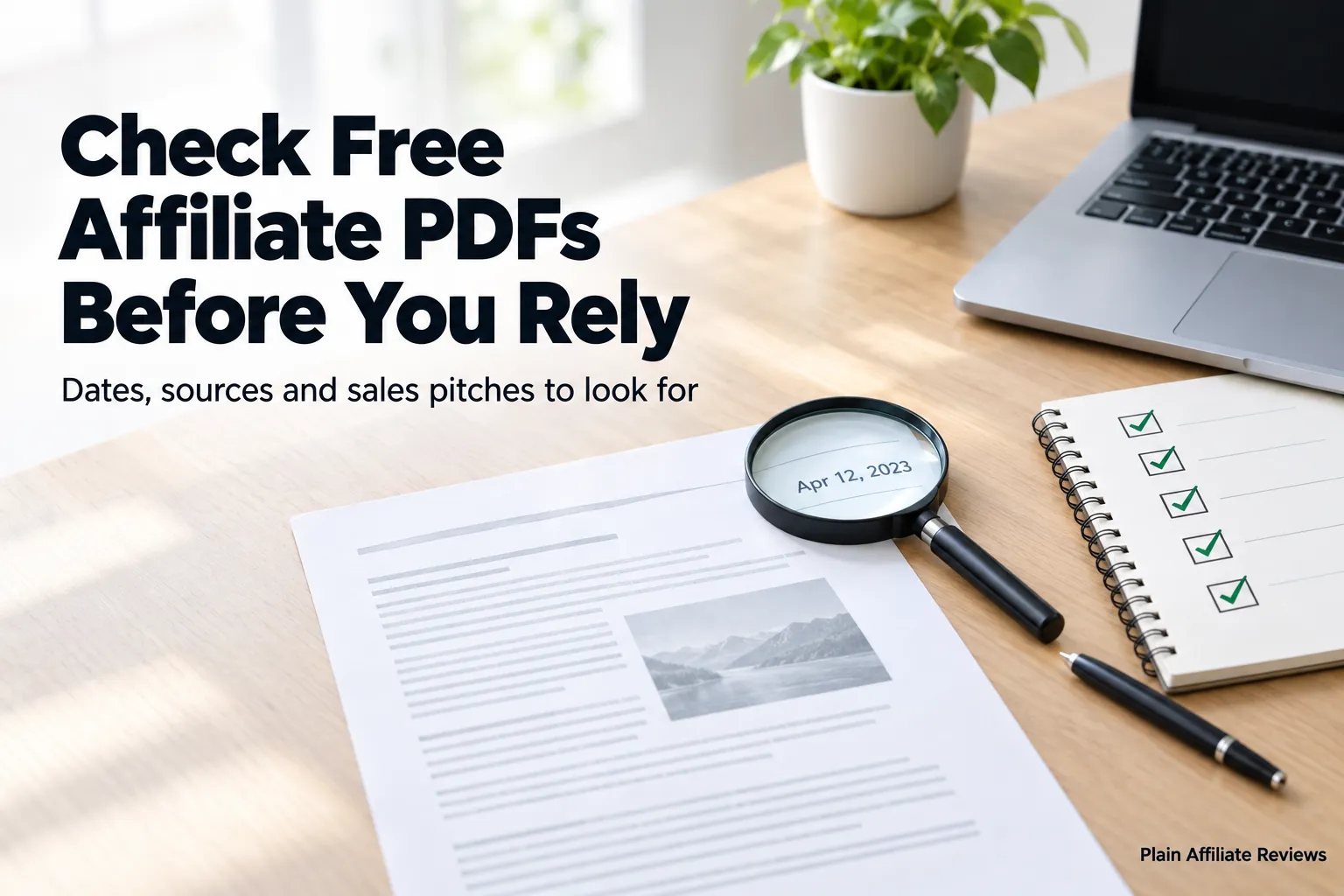
Free affiliate marketing PDFs can be useful for learning the basics, but they vary widely in accuracy and some exist only to sell a paid product. Before relying on one, check its publication or update date, confirm that the sources it cites are real and current, and look at whether the author has a stake in the products recommended. Watch for income promises without a method and for pages that push you toward a paid upgrade.
Some links on this site are affiliate links: if you buy through one, the site may earn a commission at no extra cost to you. More about this.
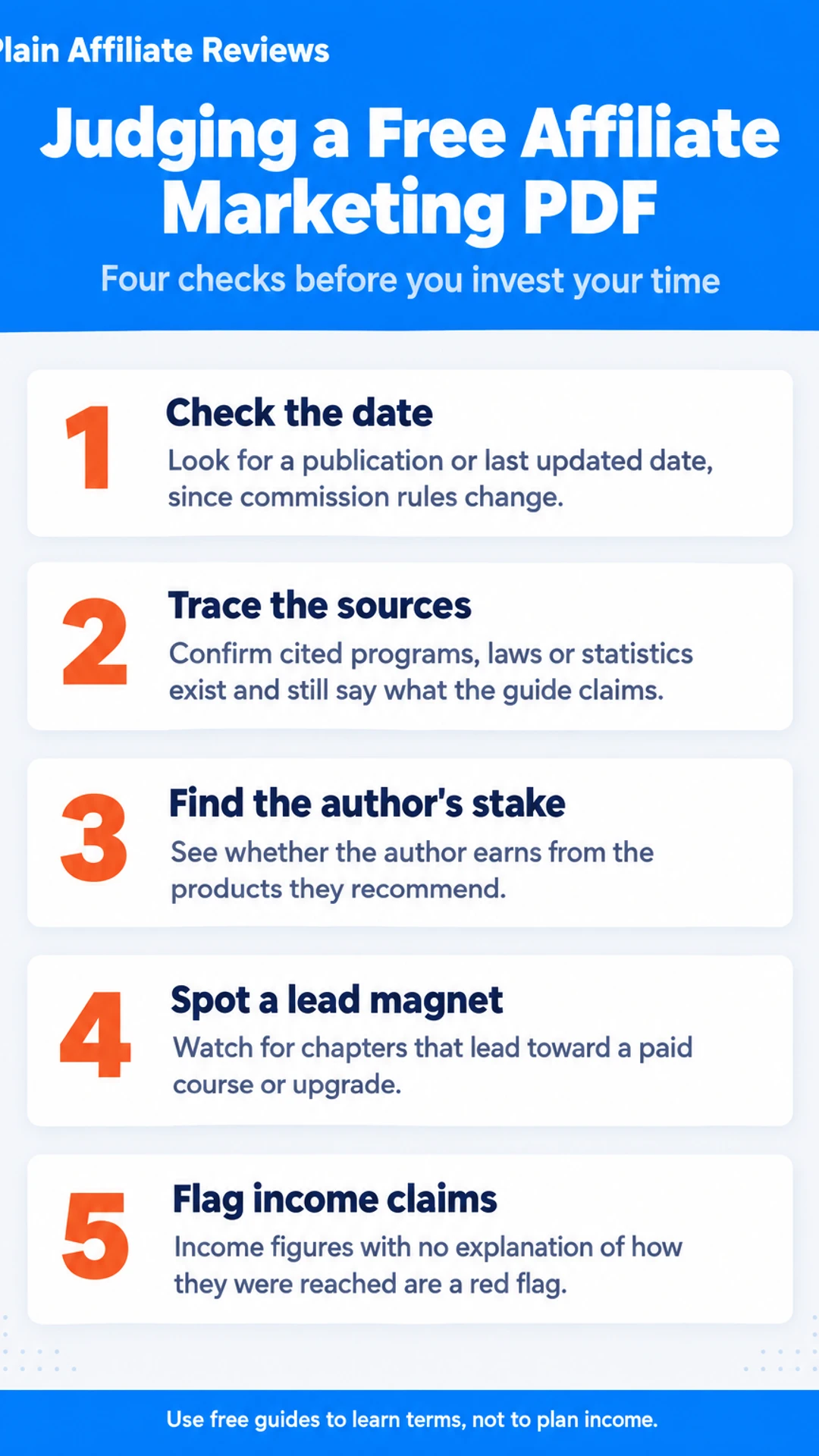
Dates: an undated PDF may still describe platform rules, commission structures or ad policies that have since changed. Sources: check that any cited study, program terms or tool actually exists and still says what the guide claims. Incentives: find out whether the author earns from the products they recommend, or whether the PDF is a lead magnet for a paid course. Red flags: income figures with no explanation of how they were reached, and pages that keep steering you to an upgrade.
You have probably already felt this problem. You download a free guide, it looks organized, and then three chapters in you find a link to a paid program that the whole guide was quietly building toward. Or you spend an evening on a PDF only to discover its advice refers to a traffic method that stopped working a while ago. Your time is limited, and a free guide can still cost you that time.
This article gives you a practical way to judge a free affiliate marketing course PDF before you put effort into it. You will learn how to read the dates and cited sources, how to spot a guide built to sell, and how to tell useful basics from outdated or misleading claims. Plain Affiliate Reviews, as a focused review site, is also explaining here how we approach these checks. The later pages in this hub cover paid courses, certificates and specific programs, so you can compare free and paid options on the same terms.
What a Free Affiliate Marketing PDF Can Teach You
Affiliate marketing is a simple idea at its core. You promote another company's product, and when someone buys through your link, you earn a commission on the sale or a fee for a lead, such as a signup. You do not create the product, handle customer service or hold inventory. Your job is to bring the right person to the offer.
A free PDF is usually good at explaining the basics. You can expect clear definitions of terms like affiliate, commission, merchant and conversion. Most guides also explain how tracking links work: each link carries a unique code so the merchant knows which affiliate sent the buyer. They typically walk through the general steps to start, such as choosing a niche, picking a few programs, creating content and driving traffic from a website, a YouTube channel, social media or search.
Where a free guide tends to stop is the details that change over time or depend on the specific program. Expect little on:
- The actual terms of a particular affiliate program, including cookie length, payout thresholds and what counts as a valid sale
- Current tax and disclosure rules, which vary by country and change
- Realistic timelines to first income, which depend heavily on traffic and niche
Some of these gaps matter more than others. Program terms and disclosure rules are where a guide can go out of date without anyone noticing, so check them against the source.
Treat a free PDF as a starting point for learning, not a finished business plan. It can give you vocabulary and a rough map. It cannot tell you which programs pay reliably, how long your own site will take to earn, or whether a paid upgrade is worth the money. Those answers come from checking primary sources and testing your own approach.
Free PDF guides compared on what they cover
| Topic | Free PDF usually covers | Often left out |
|---|---|---|
| Core terms | Affiliate, commission, merchant, conversion | Current program terms |
| Tracking links | How unique codes identify the affiliate | Specific cookie length |
| Getting started | General steps: niche, programs, content, traffic | Realistic timeline to first income |
| Disclosure and tax | General principles | Current rules by country |
Where to Find Free Affiliate Marketing PDFs
Free guides on affiliate marketing tend to come from a handful of places, and each source tells you something different about what to expect. Knowing where a file came from is the first step in deciding whether to trust it.
The main sources are:
- Free ebook libraries and resource hubs. These sites often gather guides from many authors. Quality varies widely, and the page rarely tells you who wrote the content or when.
- Document-sharing sites. Anyone can upload a PDF here, so the file may be old, copied, or altered.
- Search results. A search for a free affiliate marketing course PDF will turn up everything from university notes to sales funnels. The top result is not necessarily the most accurate one.
- Author and company websites. These are usually the most transparent, since you can see who is behind the guide and check their other writing.
Hosting a PDF on a site does not mean the site has checked it. A file sitting on a well-known domain can still be out of date or simply wrong, so judge the document itself.
Be careful with download pages that ask for your email address before the file appears. This is common, and it does not automatically mean the guide is bad. It does mean the PDF is often a lead magnet, built to move you toward a paid product. Read the next section of this guide carefully, and look for the sales pitch before you rely on the advice.
How do I keep track of the guides I have already checked?
Keep a short list. For each PDF, note the title, where you got it, the date printed inside it, whether it names its author, and whether it pushes a paid product. Over a few months, that list makes it easier to compare guides, spot the ones that stay current, and notice which sources keep sending you sales material.
A Checklist for Judging Accuracy and Currency
Free affiliate PDFs can be genuinely useful, but a free download is not automatically a current one. Before you build a strategy around any guide, run it through the checks below. Each one takes a few minutes, and together they will catch most of the problems.
Is the date clear?
Start by looking for a publication date, a version number or a "last updated" note, usually on the cover or the final page. If you find none, treat that as a warning sign. Affiliate programs change their commission rates, cookie windows and rules often, so an undated guide may be describing a world that no longer exists.
Are there outdated references?
Scan for old platform names, retired features, screenshots that no longer match the current interface, and programs that have closed. A guide that tells you to use a tool you cannot find on its website is telling you something about its age.
Can you trace the sources?
When a PDF cites program terms, a law or a statistic, check that the source has a real, findable origin. Then open it and confirm it still says what the PDF claims. Commission terms in particular change, and a quoted figure from years ago is easy to find but may no longer apply.
Who wrote it?
Look for an author name, a way to contact them, and a disclosure of which products they earn from. An anonymous guide that recommends one specific course deserves extra scrutiny, because a free PDF is often a lead magnet for a paid product.
Do the claims hold up on official pages?
Pick three or four specific claims and check them against the official pages of the programs or platforms mentioned. If the claims do not match, you have your answer about how far to trust the rest.
Is the Free Guide Really a Lead Magnet?
A free PDF is often the first step in a sales funnel. The guide gives you something useful, you hand over your email address to get it, and then the seller follows up with emails that lead to a paid course or program. This is called a lead-magnet pattern, and it is common in online business circles. It does not make the guide worthless, but it does mean the guide was built with a purpose beyond teaching you.
Some warning signs can help you spot it:
- The guide ends in one long pitch, with the actual teaching fading out before the last few pages.
- Most chapters promise a "step" or "secret" and then say the details are in the paid course.
- The author's main offer is always a higher-priced product, rather than a tool or resource you could use on its own.
- The download link sits on a page with a countdown timer or a "only a few spots left" message.
- Income claims appear with no method, process or named sources behind them. "I made $5,000 last month" tells you nothing about how.
A sales pitch is not automatically a scam. Plenty of honest sellers want to be paid for good material. But it does mean the free content is a sample of what they want to sell you, so judge it that way.
Before you rely on a free PDF, read it through once and mark each section as either general teaching or a step toward a purchase. General teaching is anything you could check or use without buying: how affiliate links work, how programs pay, how to pick a niche. Purchase steps are anything that needs the paid course to finish. If most of the guide falls in the second group, treat it as marketing, not a manual. Check the date too, since affiliate rules and platform policies change often.
Red Flags That Should Stop You Relying on a PDF
Free guides are useful, but some are built to collect your email, not to teach you. Before you spend an evening working through one, check for these warning signs. If you see one or two, you can usually drop the guide and move on.
Income claims with no explanation
Be wary of any PDF promising guaranteed or fast earnings, such as "make $5,000 a month in 30 days," without saying how that number was produced, what the starting audience was, or how much time and money were involved. Results that cannot be traced to a method are not evidence.
An author you cannot check
Look for a real name, a traceable history of writing or teaching about affiliate marketing outside the PDF, and a way to contact them. A stock photo, a name that appears nowhere else online, or an author whose only credential is the guide itself should make you cautious.
Promoting products the author has not used
If the PDF recommends programs or products without showing the author has used them, and gives you no way to verify that experience, the advice is a sales list, not a strategy.
Skipping disclosure
Affiliate links are normal, but reputable guides say so. A guide that tells you to hide affiliate relationships from readers is working against the people it claims to help, and it often signals that the content exists to earn commissions.
Depending on one traffic source
A strategy built only on one platform, such as a single social network or video site, is fragile. Platforms change their rules and algorithms, and a guide that does not account for that is already out of date. Check the publication date too, and whether the advice still matches how search engines and content platforms work today.
When a Free PDF Is Enough and When to Consider Paying
A free, checked guide is usually enough to learn the basics of affiliate marketing and to decide whether it suits you. You can learn how affiliates earn commissions, how a tracking link works, and what a content site or a YouTube channel has to do before any sales appear. If a free PDF covers those things clearly and points to real sources, you have what you need to start testing ideas on a small website or channel of your own.
Paid courses can add structure, feedback, or deeper material on a specific niche, such as blogging for affiliates or running paid search. They do not guarantee results, though, and their income claims deserve the same scepticism you would give a free PDF. Treat a paid course as a product to evaluate, not as a shortcut.
Before you pay for anything, check a few things:
- Look for independent reviews, and notice whether the reviewer earns commissions from the product.
- Read the published terms of any affiliate program the course promises to get you into, including how payouts are calculated and what triggers them.
- Ask what you will still have to do yourself. Most of the work, including writing, traffic building, and consistent posting, usually stays with you.
- Check whether the course's advice is dated. Program rules and platform algorithms change, so look for recent update dates.
Set a budget and a time limit before you start. Be realistic that affiliate income usually takes months of consistent work to appear, and often longer. If a course promises quick money, that is a reason to slow down and check the claim.
What hands-on reviewers found
These are other people's hands-on tests, summarised and credited to them. Watch the full videos for their complete reviews.
NoBSIMReviews: Master Affiliate Profits Review - What You Need To Know!
The reviewer concludes that Master Affiliate Profits is not a scam and that experienced marketers with existing traffic can make money with it, but that its upgrade-to-earn structure makes it a high-risk pay-to-play model that resembles a p
- The reviewer says most public reviews of MAP are written by affiliates, and cites a Reddit review that reads as an AI-written sales pitch without explaining how the platform works. (at 1:14)
- The reviewer notes the MAP Hall of Fame leaderboard looks impressive, but most listed earners already have existing audiences to promote MAP to. (at 1:39)
- The reviewer says MAP is not a scam and that, with existing traffic, they could generate a lot of commissions by plugging it into their channels. (at 2:11)
The InBetween: Master Affiliate Profits Review - Is This System Legit?
Erica thinks Master Affiliate Profits is a training system with heavy upsells and a traffic-dependent income model she would not rely on, and she prefers her own digital leasing model.
- Says the training is simple and organized, which suits beginners, but several features stay locked unless the buyer upgrades. (at 1:14)
- Reports that the lower membership levels include basic training while most bigger features sit behind upgrades, with Platinum presented as the level that unlocks free traffic rotation. (at 2:04)
- Notes that online reviews mix praise for the organized training and lead ownership with complaints about constant upsell reminders, shallow training depth, weak traffic rotation and autoresponder compatibility. (at 3:16)
Frequently asked questions
How do I join affiliate marketing with no money?
Most affiliate programs are free to join. You sign up, get a unique tracking link, and promote products on a blog, social channel or email list. The main costs are your time and, if you build a site, a domain and hosting. Read the program's terms before you sign up, since some programs require a purchase or a paid tier to earn commissions.
What are the different types of marketing?
Common types include content marketing, email marketing, social media marketing, search engine optimization, paid advertising, and affiliate marketing. Affiliate marketing pays you a commission when someone buys through your link, so your results depend on the traffic you can send. Each type needs different skills and often different tools and budgets.
Is affiliate marketing still worth it in 2026?
It can be, but the answer depends on your situation. Affiliate income usually comes from consistent content and an audience that trusts your recommendations, and it often takes months before commissions become regular. Beginners should check how a program pays, what the terms require, and whether they can realistically reach buyers before spending money on training.
How long did it take you to start making $5000 a month through affiliate marketing?
I have not made $5,000 a month through affiliate marketing, so I cannot give a timeline from my own experience. Income figures vary widely and depend on traffic, niche and effort. If a course or review gives you a specific timeline, check whether the person giving it has verifiable income records.
How do I check whether a free affiliate marketing PDF is accurate and current?
Look for a publication or update date, and check that the advice covers current platform rules and tools. Verify key claims against the official documentation of the programs or platforms it mentions. Also check whether the PDF's main purpose is to lead you to a paid product, since a lead magnet may leave out important details.
Wrapping up
A free affiliate marketing PDF is only useful if its information is dated, sourced and not mainly there to sell you something. Check the date, verify claims against official sources, and notice whether it pushes a paid upgrade. Have you found a free guide that held up when you checked it? Share it in the comments.
If you want to look at what the Master Affiliate Profits offer includes before deciding anything, Visit the official site. The page describes a done-for-you system with a free account sign-up, so read what it says about access and any paid levels yourself before you commit.