Master Affiliate Profits ReviewHigh Ticket Affiliate Marketing: Higher Pay, Higher Risk, and What to Check First
High Ticket Affiliate Marketing: Higher Pay, Higher Risk, and What to Check First

The short answer
High ticket affiliate marketing means promoting products that sell for hundreds or thousands of dollars and pay commissions of roughly $100 to $1,000 or more per sale. Each sale pays well, but fewer people buy, and the buyer usually needs an existing audience or traffic source. Before joining, check the payout terms, whether you must pay to earn commissions, the refund policy, and how dependent the income is on your own ongoing promotion.
Some links on this site are affiliate links: if you buy through one, the site may earn a commission at no extra cost to you. More about this.
If you have searched this topic on Reddit or elsewhere, you have probably run into the same mix of excitement and suspicion. The numbers in the pitches look huge, yet the advice in discussion threads often contradicts itself, and it is hard to tell which comments come from people who earned money and which come from people selling a course. That confusion is reasonable, and it is why a careful check beats a quick decision.
This article explains how high ticket programs work, where their pay comes from, and why the same offer can be a good opportunity for one person and a costly mistake for another. You will see the trade-offs in payout and conversion, the upgrade structures that some programs use, and the specific questions to ask before you join or pay for anything.
Here is what the article covers:
- How the payout math works: why a large commission can still produce little income when few people buy.
- Pay-to-earn structures: how upgrade tiers can decide whether you earn at all.
- Traffic dependence: why income stops when your promotion stops.
- Refund and payout terms: what to read in the published terms before committing.
- Questions to ask first: a short checklist you can apply to any program.
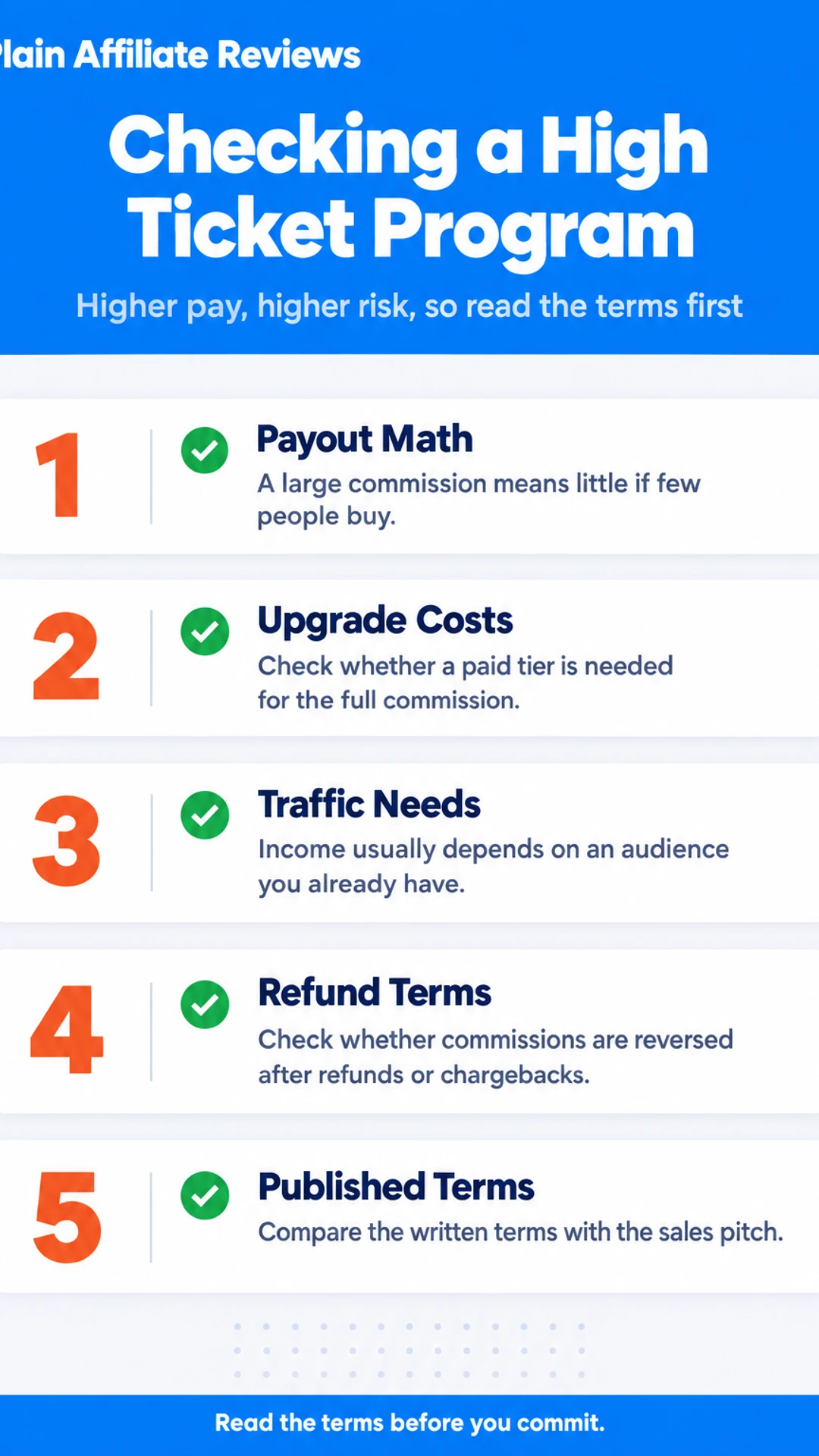
What the Trade-Off Looks Like at a Glance
| Factor | Upside | Downside |
|---|---|---|
| Commission per sale | Often $100 to $1,000 or more | Fewer buyers convert |
| Sales cycle | Large single payouts | Long wait before first commission |
| Traffic needs | Relevant audience pays off well | Beginners without traffic struggle |
| Entry cost | Access to premium offers | Paid upgrades may be required |
What High Ticket Affiliate Marketing Means
High ticket affiliate marketing is promoting products or services that sell for hundreds or thousands of dollars. Instead of a $30 ebook or a $50 software subscription, you are sending people toward a $500 course, a $2,000 coaching program or a $5,000 certification. Because the price is so much higher, the commission per sale is higher too. Many high ticket programs pay somewhere between $100 and $1,000 or more for a single sale.
Lower-priced affiliate offers usually work through a direct link. A reader clicks, buys and you get paid. High ticket offers rarely work that way. Most are sold through a webinar, a short video series or a multi-step sales funnel, where the buyer gets several emails, a sales call or a live presentation before they commit. Your job is often to send qualified traffic into that funnel and hope a share of it converts.
That is why a bigger commission is not the same as more income. A program that pays $500 per sale sounds far better than one paying $25, but if it converts one visitor in several hundred, the math can look very different from what the headline suggests. You need to think about how many people you must send to earn a single sale, and what that traffic costs you in time or money.
The Payout and Conversion Trade-Off
High ticket offers pay well per sale, but they also convert fewer of the people who see them. A tool that costs a few dollars a month is an easy yes for a stranger. A program that costs several hundred dollars needs far more trust, and most visitors will never click through to buy. That means the per-sale payout is only half the picture. The other half is how many qualified visitors you can reach.
In practice, reaching a meaningful income usually depends on a sizeable, relevant audience. A small blog with a few hundred monthly readers may see one or two sales of a cheap product in a good month. The same blog promoting a premium program might see nothing for a long stretch. Relevance matters as much as size, because a reader who already wants the outcome the program delivers is far more likely to buy.
Why does a beginner without traffic struggle?
A cold beginner usually has no list, no audience and no traffic plan. When you have none of these, you are asking strangers to spend a large sum with someone they have never heard of. Several things tend to go wrong:
- Visitors arrive from search or social media with no existing relationship
- Trust has to be built from scratch, often within a single page
- Expensive offers need proof, and new sites rarely have it yet
- Without a list, there is no second chance to reach people who hesitated
Hands-on reviewers have made this same point. NoBSIMReviews, in a review of Master Affiliate Profits, argues that a complete beginner with no email list, audience or traffic strategy will not earn much just by signing up. The reviewer's view is that the model rests on traffic the marketer already has.
When does income first show up?
High ticket sales cycles are long. Buyers research more, compare options, wait for payday and often need several touchpoints before they decide. That delay means you may spend weeks or months creating content before the first commission arrives, and some of your effort may never convert at all. If you are counting on a quick return, this is the stage where many people give up or overspend.
Erica of The InBetween makes a related point about paying a large sum up front. She notes that affiliate income takes time to appear, which makes a big initial payment feel risky for a newcomer.
Questions to Ask Before You Join a Program
High ticket affiliate programs pay large commissions on expensive products, so a single sale can be worth far more than a typical low-cost offer. That is the appeal. It is also why the terms deserve a close read before you put in any time or money. The checklist below covers the questions worth asking of any high ticket program, including Master Affiliate Profits.
Do I have to buy a paid tier to earn the full commission?
This is the first thing to check. Some programs pay the advertised rate only after you upgrade, and the upgrade can cost hundreds of dollars. Find out what the tier costs, what it includes, and whether the commission you were shown is available on the free level.
- Is the headline commission rate locked behind a paid upgrade?
- What does that upgrade cost, and is it a one-time payment or recurring?
In a review of Master Affiliate Profits, NoBSIMReviews describes the $797 Platinum tier as the level needed to earn the advertised 75% commission, and calls the model a high-risk pay-to-play structure. Erica from The InBetween makes a similar point about features that stay locked until you upgrade. Both are worth weighing against the claims you see on the sales page.
What is the refund and chargeback policy?
Ask whether commissions are reversed when a buyer refunds or disputes a charge. If they are, a sale you were paid for can be taken back later. Read the policy in full and note how long the refund window runs.
Do the published terms match the sales pitch?
Compare the commission rate, the payment schedule and the minimum payout against the sales video and the written terms. Note how payments are made and when. If the pitch and the fine print disagree, trust the fine print and ask the company to explain the gap in writing.
What training, traffic and tools are included?
Make a list of what the program offers and mark which items need an upgrade. Traffic in particular matters: a program that depends on you already having an audience will only pay you if you bring visitors. NoBSIMReviews notes that many top earners on leaderboards already had audiences before they joined.
Pay-to-Earn Structures Compared
| Structure | Pros | Cons |
|---|---|---|
| Free tier with standard commission | No upfront fee to join | Headline rate may not be available |
| Paid upgrade for full commission | Advertised rate unlocked | Cost can reach several hundred dollars |
| Recurring upgrade fees | Access continues over time | Ongoing costs reduce net income |
Spotting Pay-to-Play and Pyramid Warning Signs
High ticket programs often pay a large commission on a large sale, which is exactly why they attract so much attention. Before you join one, check what you are actually being paid to do. Some programs earn most of their money from people buying in, not from customers buying a product they would use.
What should I look for first?
Start with the money flow. If the main reason to pay is to gain access to resell the program, or to recruit other people into it, treat that as a serious warning. The FTC has described this kind of structure as characteristic of pyramid schemes. Ask yourself where the income comes from if no new recruits ever join.
Watch for these signs:
- The biggest earnings require you to upgrade, and the commission only works at the top tier.
- You are told the real opportunity is in promoting the upgrade to others.
- Income claims lean on a leaderboard or "top earners" without explaining how those people started.
- Pressure to buy quickly, with reminders to upgrade appearing constantly.
Do leaderboards show what I can earn?
Usually not. A leaderboard shows who sold the most, not how typical those results are. In NoBSIMReviews' review of Master Affiliate Profits, the reviewer said the Hall of Fame looks impressive, but most listed earners already had audiences to promote to. A beginner without that starting traffic is in a very different position.
In The InBetween's hands-on review, Erica said the training was simple and organised, but that many features stayed behind upgrades. Being well taught and being able to earn are not the same thing.
If you are comparing programs, ask the seller how a typical new member with no audience is doing, and whether they will show that data.
Reading Reddit and Reviews With a Critical Eye
Before you give weight to any review, ask one question: does the person writing it make money if you buy? Many public reviews of high ticket programs come from affiliates, and an affiliate earns a commission when you sign up through their link. That doesn't make every review dishonest, but it does mean you should look for a disclosure, a link you can click, or a clear statement of who benefits.
NoBSIMReviews, in his review of Master Affiliate Profits, said that most of the public reviews he saw were written by affiliates. He pointed to a Reddit post that read like an AI-written sales pitch and never explained how the platform actually works. That is a useful test to apply yourself.
Here is what to check as you read:
- Does it explain the mechanics? Look for specifics such as how commissions are calculated, what you must upgrade to earn, and how traffic is delivered. Generic praise or copied sales copy tells you little.
- Does it describe the training in detail? A useful review names the lessons, the tools, and what is missing.
- Do complaints repeat? One unhappy buyer is noise. The same complaint about upsell reminders, shallow training, or weak traffic across many separate posts is a pattern worth noting.
- Is the reviewer's own money at stake? Reviews from people with no commission and no stake in your decision are generally more useful, though you should still weigh their experience against their situation.
The Reddit threads that help most are the ones where people describe what they actually did, what it cost them in time and money, and how long it took before any income appeared. Those details are harder to fake than enthusiasm, and they are the details you need before spending money.
Time, Money and Dependence on Your Own Effort
High ticket affiliate programs pay more per sale, which is why they attract attention. The trade-off is that you usually have to spend money or time before any of that pay arrives, and nothing guarantees it will.
Up-front spending is the main risk for newcomers. Many people who search for high ticket affiliate marketing on Reddit are weighing a fee against an income that has not appeared yet. Commissions can take months to show up, and many beginners earn nothing at first. Treat any fee as money you may not get back, and only spend what you could afford to lose.
Your income also depends on your own effort. In NoBSIMReviews' assessment of Master Affiliate Profits, the reviewer argues that a beginner without an email list, an audience or a traffic plan will not earn much just by signing up. The InBetween's reviewer makes a similar point: affiliate income tends to stop when you stop posting, or when a search algorithm or platform changes. A single traffic source drying up can cut your earnings quickly. Ask yourself what happens to your income if you take a month off.
Before paying for a large program, you can limit the risk:
- Start with free or low-cost training and check whether the advice is current and specific.
- Choose the smallest paid tier that covers what you need, and ask what is locked behind upgrades.
- Test with a small, reversible step, such as one page or one promotion, before committing more.
- Set a clear point at which you will stop spending if no sales arrive.
For a broader comparison of training options, see the guide to the best affiliate marketing courses compared.
What hands-on reviewers found
These are other people's hands-on tests, summarised and credited to them. Watch the full videos for their complete reviews.
NoBSIMReviews: Master Affiliate Profits Review - What You Need To Know!
The reviewer concludes that Master Affiliate Profits is not a scam and that experienced marketers with existing traffic can make money with it, but that its upgrade-to-earn structure makes it a high-risk pay-to-play model that resembles a p
- The reviewer says most public reviews of MAP are written by affiliates, and cites a Reddit review that reads as an AI-written sales pitch without explaining how the platform works. (at 1:14)
- The reviewer notes the MAP Hall of Fame leaderboard looks impressive, but most listed earners already have existing audiences to promote MAP to. (at 1:39)
- The reviewer says MAP is not a scam and that, with existing traffic, they could generate a lot of commissions by plugging it into their channels. (at 2:11)
The InBetween: Master Affiliate Profits Review - Is This System Legit?
Erica thinks Master Affiliate Profits is a training system with heavy upsells and a traffic-dependent income model she would not rely on, and she prefers her own digital leasing model.
- Says the training is simple and organized, which suits beginners, but several features stay locked unless the buyer upgrades. (at 1:14)
- Reports that the lower membership levels include basic training while most bigger features sit behind upgrades, with Platinum presented as the level that unlocks free traffic rotation. (at 2:04)
- Notes that online reviews mix praise for the organized training and lead ownership with complaints about constant upsell reminders, shallow training depth, weak traffic rotation and autoresponder compatibility. (at 3:16)
Frequently asked questions
What is a high ticket affiliate business?
A high ticket affiliate business promotes products or services with a high sale price, often several hundred or several thousand dollars, and earns a commission on each sale. Each conversion pays far more than a typical low-cost product, but fewer people buy, so the business depends on reaching the right audience and converting it carefully.
Do I need a website for affiliate marketing?
Not always, but most affiliates rely on some owned channel, such as a website, email list or social profile, because platforms can change their rules or shut accounts down. A blog or email list gives you a place to build trust before recommending an expensive offer, which matters more when the price is high.
Which pay-per-click affiliate programs offer the highest earnings?
Pay-per-click programs pay for clicks rather than sales, so earnings depend on traffic volume and the rate per click. Published payout rates vary widely between networks and offers, and the figures change, so check the current terms of any program you are considering. Earnings from clicks are often small unless the traffic is large and well targeted.
Can you actually make money doing affiliate marketing?
Yes, some people do, but income usually takes months of consistent work to build traffic and trust, and most beginners earn little at first. Results depend on the audience you can reach, the offers you choose and how honestly you promote them. Be skeptical of any claim that money arrives quickly or with little effort.
What should I check before joining a high ticket affiliate program?
Look at how the commission is paid, whether the product is refundable, what the program requires you to buy first, and who the public reviews are written by. Ask whether you already have an audience to promote to. If the program needs a large upfront payment before you can earn, weigh that cost against the time it may take to see any return.
Wrapping up
High ticket affiliate marketing pays more per sale, but it also means fewer sales, longer waits and more money at risk before you see a return. Check how commissions are paid, what you must buy first and whether you already have an audience before committing. Have you joined a high ticket program before? Share what you checked first in the comments.
If you want to look at the offer behind this review in more detail, Visit the official site to see what the page describes, including its free access option and the membership it promotes, then compare that against the questions above before deciding.