Master Affiliate Profits ReviewHow to Check Whether a Free Affiliate Marketing Ebook Is Still Accurate
How to Check Whether a Free Affiliate Marketing Ebook Is Still Accurate
The short answer
To check a free affiliate marketing ebook, look first at its publication date and at any platform rules or tools it names, since those change fastest. Then check each income claim for the traffic, time and budget it assumed and whether the figure has a named, verifiable source. Finally, confirm that recommended programs still exist and publish the stated commission terms. Advice that holds up on all three checks is reasonable to rely on.
Some links on this site are affiliate links: if you buy through one, the site may earn a commission at no extra cost to you. More about this.
If you have ever downloaded a free PDF on affiliate marketing and felt unsure whether it still applies, you are not alone. Many of these guides were written for an earlier version of search engines, social feeds or affiliate networks. The income examples in them often leave out the audience size and spending that made them possible. That gap is easy to miss when a guide promises steady commissions from a few weeks of posting.
This page gives you a short method you can run in about fifteen minutes on any free ebook. It covers how to date the advice, how to test income claims against the traffic and budget behind them, and how to confirm that programs and commission terms are real today. Along the way it draws on hands-on reviews of Master Affiliate Profits by other creators, credited to them, which show where similar claims tend to come unstuck.
Dating the advice: how to spot which parts of an ebook are most likely out of date. Testing income claims: how to ask what traffic, time and budget a figure assumed. Confirming programs and terms: how to check that a recommended program still exists and publishes its commission rate. Spotting lead magnets: how to tell a useful free guide from a funnel built to sell a paid upgrade.
What Free Affiliate Marketing Ebooks Usually Cover
Before you can tell whether a free ebook is still accurate, you need a clear picture of what a solid one should contain. Start with the basics. Affiliate marketing means you promote someone else's product and earn a commission when a tracked sale or lead comes from your promotion. You do not create the product, handle delivery, or usually handle customer service. Your job is to send the right people to the offer.
Most affiliate programs use a unique tracking link, sometimes called an affiliate link. It contains a code that tells the merchant which partner sent the visitor, so the commission can be credited. Programs differ in what they pay for: a completed sale, a free trial signup, or a form submitted. Partner types also vary. Some people run blogs, some run YouTube channels, some run email lists, and some use paid ads.
A sound beginner guide, free or paid, should cover at least four things:
- Niche choice: how to pick a topic narrow enough to serve a specific audience.
- Program selection: how to judge whether a program pays reliably and whether its terms are fair.
- Traffic sources: where your visitors will come from, such as search, social media, or email.
- Realistic timelines: how long it typically takes before any income shows up.
If a guide skips these or promises income without explaining the work, treat that as your first warning sign. Strategies that skip the work are usually the first to fail a check.
Step 1: Check the Date and the Parts That Change
Start with the date. Look for a publication date, a "last updated" line, or a copyright year near the top or bottom of the ebook. If you cannot find one, treat that as a warning sign in itself. For anything about platforms, such as search engines, social media or ad networks, be cautious with material more than a few years old. These rules change often, and advice written before a major update may now cost you traffic or get your account flagged.
Once you have the date, check the parts of the book most likely to have aged. These are the fast-changing elements:
- Search engine and social media rules, including how they treat sponsored links, AI-generated content and link building
- Ad platform policies, especially on what affiliate promotions are allowed and how landing pages must be labelled
- Named tools and their pricing, which can rise, change tiers or disappear
- Named networks and programs, which may have closed, merged or stopped accepting new affiliates
Then check whether the named tools, networks or programs still exist and still accept affiliates. Visit the official site yourself, rather than following the book's link, and look for a current affiliate page with published terms. If a program has been shut down or no longer pays out, the strategy built around it is out of date regardless of how good the writing is.
Be wary of any income claim in a free ebook. Ask what the author based it on, and whether a current, checkable source backs it up. A free book can also be a lead magnet for a paid upsell, so note whether the claims depend on buying something else. The free guide you are reading should earn your trust with specifics you can verify, not with figures you cannot trace.
How each check works
| Check | What to look for | Warning sign |
|---|---|---|
| Publication date | Date or last updated line | No date at all |
| Platform rules | Current search and ad policies | Rules older than a few years |
| Named tools | Current pricing and tiers | Pricing or tools no longer exist |
| Named programs | Still open to affiliates | Closed, merged or not paying out |
Step 2: Test Every Income Claim
Once you have a free affiliate marketing ebook in front of you, the income examples inside it are where most of the trouble hides. A figure like "I made $3,000 last month" sounds useful, but on its own it tells you very little. Before you accept it, read it the way you would read any sales claim.
Ask what the example assumed. Every earnings result depends on inputs the author may not mention: how much traffic the site or channel received, how large the audience was, and how long the author had been building it. Ask yourself:
- How many visitors or subscribers did this person have?
- How long did they work before the money arrived?
- Did they already have a following before they started this method?
If the ebook cannot answer these questions, treat the number as a story rather than evidence.
Check whether the source is named and checkable. A claim that cites a specific study, a named program, or a public dashboard can be verified. "Studies show" or "a member told us" cannot. Anonymous testimonials and unnamed research should count as unverified until you can confirm them.
Find out whether the example is typical. Ask whether the author says the result is ordinary or exceptional. Many headline earners are outliers, and an honest author will say so. If the ebook never mentions that its example is unusual, assume it probably is.
Recalculate with realistic numbers. This is the test I find most useful. Take the claimed commission and work backward using traffic you could plausibly reach. Suppose an ebook says a single product link earns a sale a day. Then ask how many visitors that requires at a typical conversion rate, and whether a beginner site gets that many visits in the first months. If the math only works with a large existing audience, the claim does not transfer to a new reader.
Step 3: Verify Programs Against Their Published Terms
Once you have checked the ebook's claims for age, the next question is whether the programs it recommends still pay the terms it describes. An ebook can be accurate when written and wrong a year later, so treat every stated commission rate, cookie length and payout rule as a claim to confirm.
Does the program's own terms page match the ebook?
Go to the program's website directly, not through a link in the ebook, and find its affiliate terms. Compare three things with what the ebook says:
- Commission rate, including whether it applies to the first sale only or to recurring payments
- Cookie length, meaning how many days after a click a sale still counts for you
- Payout threshold, the minimum balance before money is released
If the ebook's figures differ from the live terms, trust the live terms and note the difference. Save a copy or screenshot of the page with its date, since terms change without notice.
Are the payment terms clear?
Check the minimum payout amount, the payment schedule (weekly, monthly, or on request) and the payment methods offered. Vague wording such as "payments are made at our discretion" is a warning sign. Clear programs state these details in plain language.
Has anything changed?
Look for an updated date on the terms page, and search the program's blog or support pages for recent announcements. Pay attention to rule changes that reduce commissions or add conditions.
Is an upsell required to earn?
Some programs only pay commission once you buy a higher membership tier. If the ebook recommends a program, check whether a paid upgrade is needed to earn the rate it describes. Be wary when the terms make a purchase a condition of earning. One reviewer, NoBSIMReviews, describes a similar pay-to-play structure in a review of Master Affiliate Profits and calls it high risk. You can read more in our separate page on that program's upgrade costs.
Step 4: Look for a Lead Magnet or Hidden Upsell
A free ebook is sometimes a genuine resource and sometimes a sales funnel with a few useful pages attached. The clearest way to tell the difference is to look at what the book actually asks you to do.
Start by measuring how much of it gives you steps you can carry out today. Count the pages with concrete actions, such as writing a product comparison, setting up a tracking link, or choosing a niche with a defined audience. Then count the pages that only describe what a paid course could do for you. If the second group keeps growing, the ebook is working as a brochure.
Next, read the endings. If every chapter closes with the same call to action, or with a "next level" teaser pointing to a locked program, the book is built around the upsell. A useful guide can recommend a next step without making every section a pitch.
Finally, check whether the author earns from the offers they recommend. Commissions are common in this field and not a problem by themselves, but you should know about them. Look for a disclosure near the front or in the footer, or search the author's name alongside the offer. If you cannot find any disclosure and every recommendation leads to one platform, treat the advice with more caution.
Some things to check:
- Does the ebook name specific tools, settings, or first actions you can test?
- Are income claims tied to a method you can follow, or left vague?
- Are the recommended offers disclosed as affiliate links?
A Reusable Checklist and How to Decide
When you pick up a free ebook, PDF or mini-course, you can run it through the same short checklist you would use for any guide. Score each part as pass, unclear or fail. You do not need to be an expert to do this, only willing to look at what the document actually says.
- Date. Is there a publication or update date, and does it reference recent platform rules, tools or policies? Undated content is a yellow flag, not an automatic fail.
- Claim support. Does every income figure come with a source, a method and a time frame? An income figure with no explanation is a fail.
- Program verification. Can you find the named affiliate program's current commission terms on its own website? If the ebook's numbers do not match the live terms, mark it a fail.
- Upsell balance. How often does the free material point you toward a paid product, and does it still teach something useful without buying? Heavy steering toward a paid tier is a fail.
Which advice can you trust without rechecking?
Stable fundamentals are usually safe to use. How commissions, cookies and tracking links generally work changes slowly, so you can apply that advice directly. Time-sensitive advice is different. Anything about platform algorithms, ad policies, specific payouts or which programs are currently open should be checked again before you act on it.
So, what do you do with it?
- Use it if it passes most checks and its advice is mostly fundamentals.
- Use it with checks if it is useful but has unclear dates or claims. Verify the time-sensitive parts first.
- Set it aside if it fails claim support or program verification.
Remember that no free guide can replace testing with your own traffic. Even accurate advice only shows what it can do once you have tried it with your own audience.
Trusting advice without rechecking
| Advice type | Why it holds | Why it can go stale |
|---|---|---|
| Commission basics | Changes slowly | Specific rates can change |
| Tracking link mechanics | Works the same way across programs | Tool interfaces may change |
| Platform algorithms | Not stated | Changes often |
| Ad policies | Not stated | Changes often |
| Which programs are open | Not stated | Can close or change without notice |
What to do now
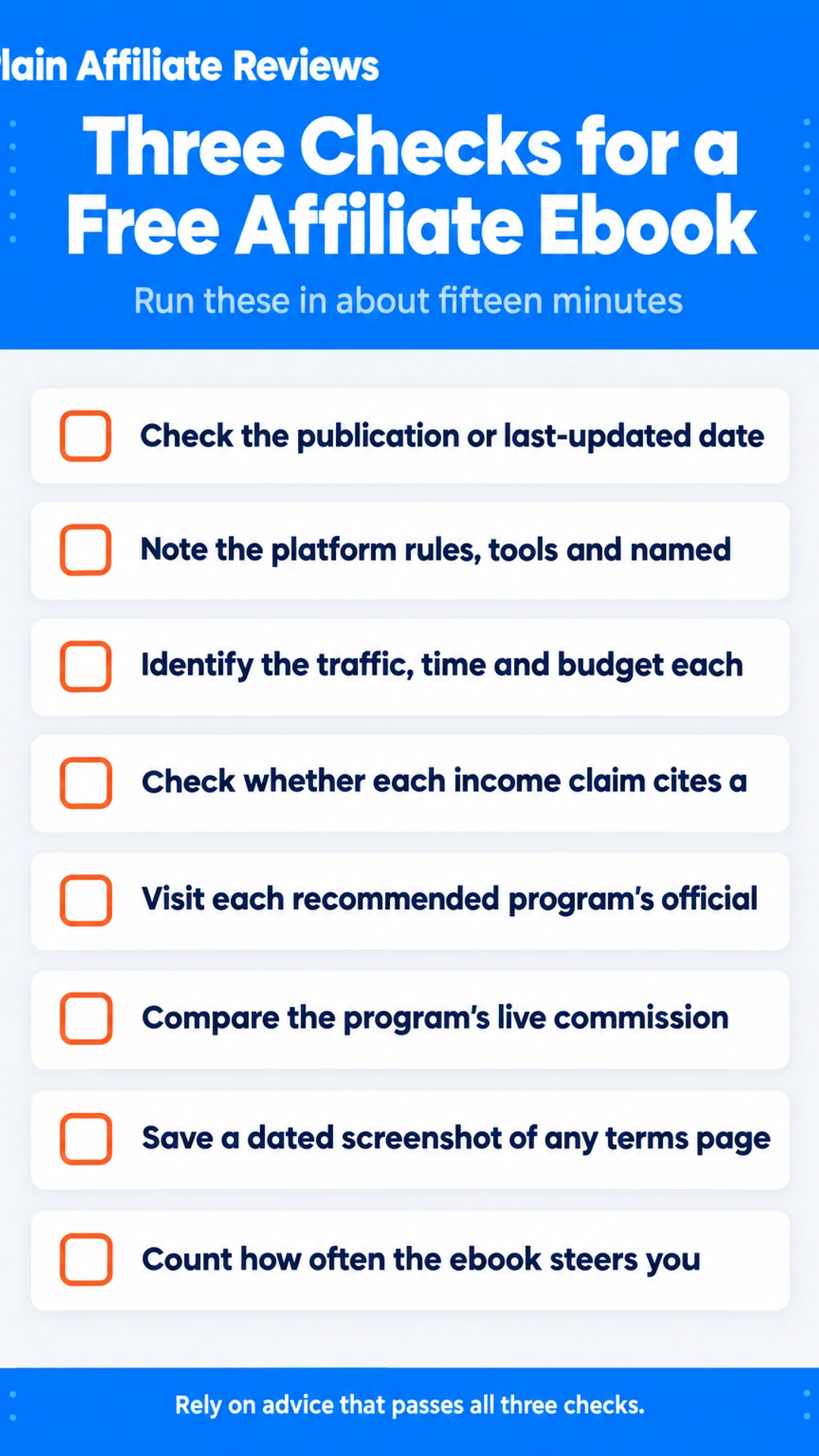
- ☐ Check the publication or last-updated date near the top or bottom of the ebook
- ☐ Note the platform rules, tools and named programs the ebook relies on, since these change fastest
- ☐ Identify the traffic, time and budget each income claim assumed
- ☐ Check whether each income claim cites a named, verifiable source
- ☐ Visit each recommended program's official site directly rather than using the ebook's links
- ☐ Compare the program's live commission rate, cookie length and payout threshold with the ebook's figures
- ☐ Save a dated screenshot of any terms page you verify
- ☐ Count how often the ebook steers you toward a paid product or upgrade
What hands-on reviewers found
These are other people's hands-on tests, summarised and credited to them. Watch the full videos for their complete reviews.
NoBSIMReviews: Master Affiliate Profits Review - What You Need To Know!
The reviewer concludes that Master Affiliate Profits is not a scam and that experienced marketers with existing traffic can make money with it, but that its upgrade-to-earn structure makes it a high-risk pay-to-play model that resembles a p
- The reviewer says most public reviews of MAP are written by affiliates, and cites a Reddit review that reads as an AI-written sales pitch without explaining how the platform works. (at 1:14)
- The reviewer notes the MAP Hall of Fame leaderboard looks impressive, but most listed earners already have existing audiences to promote MAP to. (at 1:39)
- The reviewer says MAP is not a scam and that, with existing traffic, they could generate a lot of commissions by plugging it into their channels. (at 2:11)
The InBetween: Master Affiliate Profits Review - Is This System Legit?
Erica thinks Master Affiliate Profits is a training system with heavy upsells and a traffic-dependent income model she would not rely on, and she prefers her own digital leasing model.
- Says the training is simple and organized, which suits beginners, but several features stay locked unless the buyer upgrades. (at 1:14)
- Reports that the lower membership levels include basic training while most bigger features sit behind upgrades, with Platinum presented as the level that unlocks free traffic rotation. (at 2:04)
- Notes that online reviews mix praise for the organized training and lead ownership with complaints about constant upsell reminders, shallow training depth, weak traffic rotation and autoresponder compatibility. (at 3:16)
Frequently asked questions
How do I know if a free affiliate marketing ebook is still up to date?
Look for a published date or a last-updated note, then check whether the advice refers to platforms, algorithm changes or program terms that have since shifted. Compare its claims against the current official help pages of the tools it mentions. If the most recent information is several years old, treat its specifics as unverified.
What should I do with income claims in a free affiliate ebook?
Ask what the claim is based on. A credible guide shows how the example was measured, over what period, and what traffic or audience the author had. If it gives a figure with no method, timeframe or source, treat it as a sales claim rather than evidence, and do not use it to plan your budget.
Can I check the affiliate programs an ebook recommends?
Yes. Visit each program's own site and read its current commission structure, cookie length, payout threshold and any fees or upgrade requirements. Programs change terms often, so compare what the ebook says against the live terms, and note the date you checked them.
Why do free ebooks sometimes push a paid product?
Many free guides are lead magnets, meaning they exist to collect your email and then promote a paid course or membership. That is not automatically a problem, but it means the free content may be selected to lead you toward the upsell. Notice whether the advice stays useful when the pitch is removed, or whether key steps depend on buying something.
What is a quick method for checking a free affiliate ebook before relying on it?
Start by checking the date, then verify two or three specific claims against current official sources. Look at any income examples for a stated method, and check the programs it recommends on their own sites. If most of the advice passes these checks, it is a reasonable starting point; if not, use it only for general ideas.
Wrapping up
A free affiliate guide is only useful if its facts and income claims still hold up. Check the date, verify specific claims against current official sources, and ask how any income figure was produced. Have you found a free guide that held up well, or one that fell apart when you checked it? Share your experience in the comments.
If you are weighing the Master Affiliate Profits offer itself, you can visit the official site and read what the page says about the offer before deciding.